2025-12-11 国立極地研究所,総合研究大学院大学
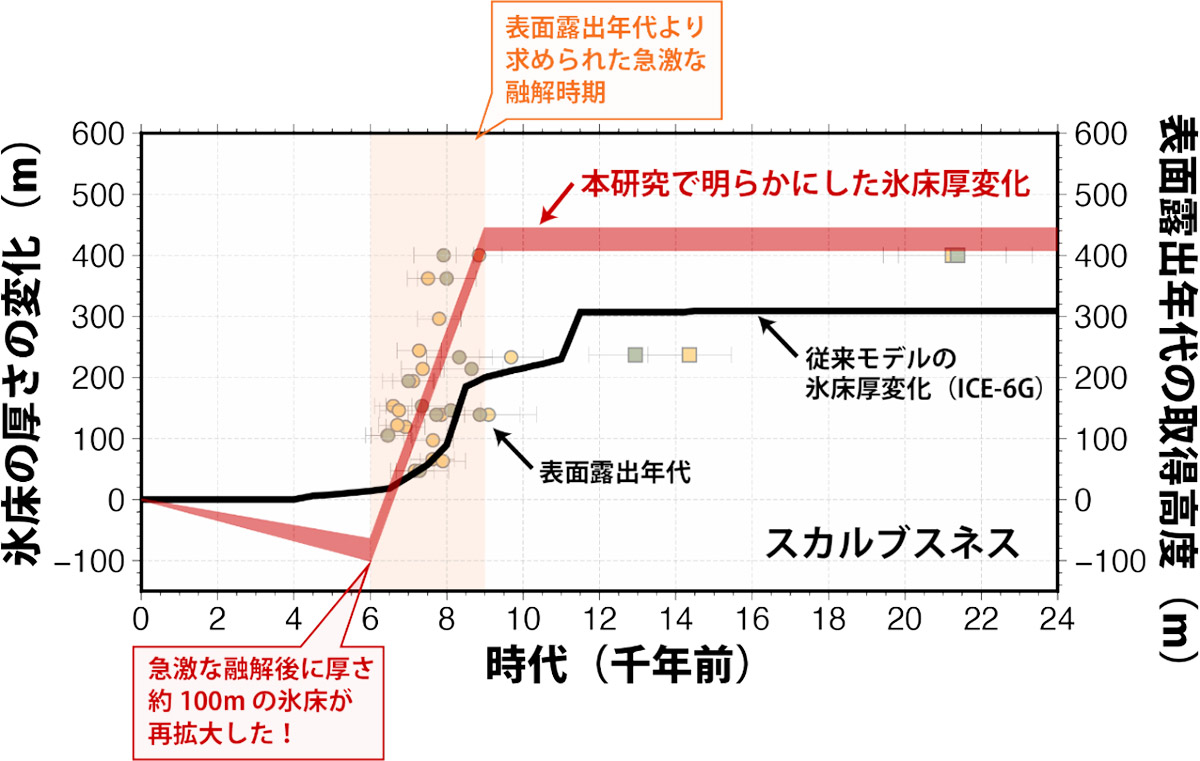
図1:スカルブスネスにおける表面露出年代データと氷床厚モデルの関係。スカルブスネス(図2)における表面露出年代データからは、9000年前から6000年前にかけて(横軸の0は現在)急激な氷床高度の低下が認められるが(文献2)、従来の氷床融解史モデル(ICE-6G)による氷床の厚さの変化は表面露出年代データを十分に説明できない。本研究の結果より、9000年前からの急激な氷床の厚さの減少を十分にモデル化した上で、GNSSデータを十分に説明しうる氷床厚の変化を求めると、急激な氷床融解後に厚さ約100mの氷床が再拡大する必要があることが明らかになった。
<関連情報>
氷河等圧調整により示唆される東南極氷床の急速な薄化と再厚化 Mid Holocene rapid thinning and rethickening of the East Antarctic ice sheet suggested by glacial isostatic adjustment
Jun’ichi Okuno,Akihisa Hattori,Koichiro Doi,Yuichi Aoyama & Yoichi Fukuda
Scientific Reports Published:17 November 2025
DOI:https://doi.org/10.1038/s41598-025-24176-4
Abstract
Understanding East Antarctic Ice Sheet dynamics during the mid-Holocene remains challenging due to complex climate interactions. Using Global Navigation Satellite System observations and glacial isostatic adjustment modeling, we investigate the ice-sheet history in the Lützow–Holmbukta region. Here we show that scenarios incorporating modest (65–100 m) ice-sheet re-thickening following previously documented rapid thinning of ~ 400 m between 9 and 6 ka provide improved agreement with geodetic observations compared with global deglaciation models. Our analysis constrains the rheological structure beneath East Antarctica, suggesting a lithospheric thickness of 50–70 km, upper mantle viscosities of 5–7 × 10²⁰ Pa s, and lower mantle viscosities of 6–80 × 1021 Pa s, which show excellent agreement with independent constraints from effective elastic thickness studies and are broadly compatible with seismological estimates. These findings highlight the need to incorporate regional ice-sheet histories when investigating past ice-sheet dynamics, which is essential for understanding present-day behavior and predicting future responses to climate change.