2025-10-16 中国科学院(CAS)
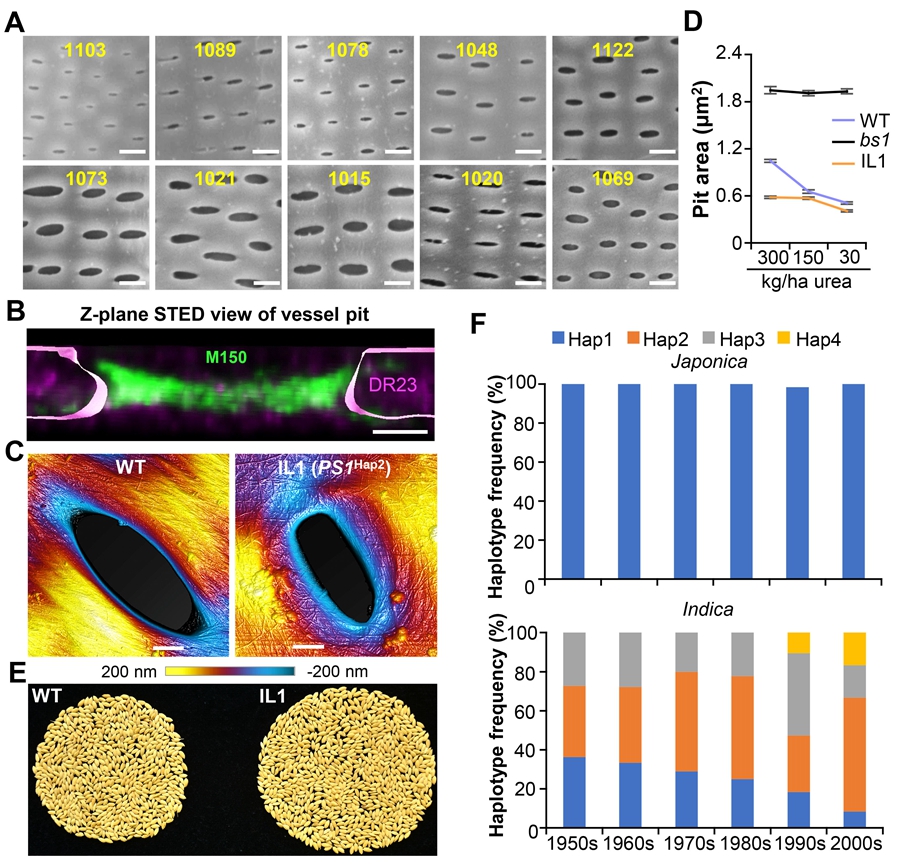
Identification of the QTL gene PS1 for controlling xylem pit size in the regulation of xylem transport and grain yield in model crop rice (Image by IGDB)
<関連情報>
- https://english.cas.cn/newsroom/research_news/life/202510/t20251016_1089546.shtml
- https://www.cell.com/cell/abstract/S0092-8674(25)01086-4
道管壁のピット構造の形成は道管水理と穀物収量を維持する Shaping pit structure in vessel walls sustains xylem hydraulics and grain yield
Lanjun Zhang ∙ Yihong Gao, ∙ Zuopeng Xu ∙ … ∙ Chengxu Gao ∙ Yihua Zhou, ∙ Baocai Zhang
Cell Published:October 14, 2025
DOI:https://doi.org/10.1016/j.cell.2025.09.018
Highlights
- PS1, a QTL for pit-size control, regulates vessel pit geometry in rice
- Hypo-acetylated xylans facilitate cellulose binding and assembly of cohesive vessel wall
- Nitrogen regulates pit size through the MYB61-PS1 module to boost adaptive growth
- Refined 3D geometry of pits in vessel walls supports xylem plasticity and crop yield
Summary
Plants have evolved a conduit system with reinforced walls and innovative wall structures that ensure efficient transport of water and nutrients. Vessel pits, fine three-dimensional (3D) cavities in conduit walls, are key determinants of plant hydraulics and growth plasticity. However, their ultrastructure and formation mechanisms are unknown. Here, we reveal the nanoscale 3D structure of pits and the molecular pathway that mediates pit shaping and sustains xylem robustness and grain yield. A quantitative trait locus for pit size (PS1), identified by a genome-wide association study in rice, is a xylan deacetylase that controls pit geometry. An elite PS1 allele modifies xylans to a hypoacetylated state, facilitating their binding to cellulose and maintaining wall coherence around pit boundaries. The elite haplotypes confer rice varieties with enhanced nitrogen transport and grain yield. We thus discover a molecular pathway that boosts xylem hydraulics and crop yield, offering a promising strategy for sustainable agriculture.