2025-09-03 明治大学
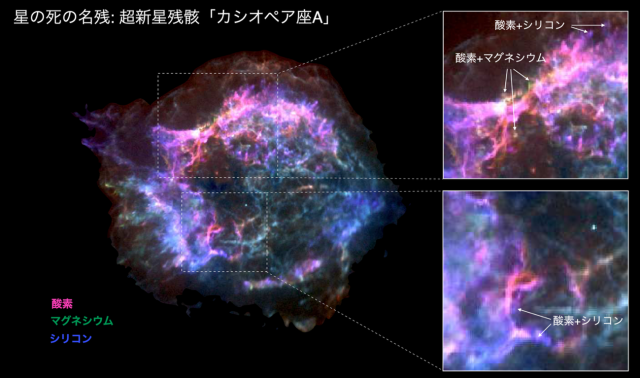
図 1: チャンドラ衛星の観測によるカシオペア座AのX線画像 (赤: 酸素、緑: マグネシウム、青: シリコン)。
三色の混合具合の違いが爆発前の恒星の激しい核燃焼過程で形成されたと考えられる。
<関連情報>
- https://www.meiji.ac.jp/koho/press/2025/qfki0t000007s3el.html
- https://iopscience.iop.org/article/10.3847/1538-4357/aded14
カシオペアA超新星発生直前数時間における不均一な恒星混合 Inhomogeneous Stellar Mixing in the Final Hours before the Cassiopeia A Supernova
Toshiki Sato, Kai Matsunaga, Hiroyuki Uchida, Satoru Katsuda, Koh Takahashi, Hideyuki Umeda, Tomoya Takiwaki, Ryo Sawada, Takashi Yoshida, Ko Nakamura,…
The Astrophysical Journal Published: 2025 September 2
DOI:10.3847/1538-4357/aded14
Abstract
Understanding stars and their evolution is a key goal of astronomical research and has long been a focus of human interest. In recent years, theorists have paid much attention to the final interior processes within massive stars, as they can be essential for revealing neutrino-driven supernova mechanisms and other potential transients of massive star collapse. However, it is challenging to observe directly the last hours of a massive star before explosion, since it is the supernova event that triggers the start of intense observational study. Here, we report evidence for a final phase of stellar activity known as a “shell merger,” an intense shell burning in which the O-burning shell swallows its outer C-/Ne-burning shell, deep within the progenitor’s interior moments before the supernova explosion. In the violent convective layer created by the shell merger, Ne, which is abundant in the stellar O-rich layer, is burned as it is pulled inward, and Si, which is synthesized inside, is transported outward. The remnant still preserves some traces of such Ne-rich downflows and Si-rich upflows in the O-rich layer, suggesting that inhomogeneous shell-merger mixing began just hours (≲104 s) before its gravitational collapse. Our results provide the first observational evidence that the final stellar burning process rapidly alters the internal structure, leaving a pre-supernova asymmetry. This breaking of spherical symmetry facilitates the explosion of massive stars and influences various supernova and remnant characteristics, including explosion asymmetries and the neutron star’s kick and spin.