2025-04-17 オーストリア・ウィーン工科大学(TU WIEN)
<関連情報>
- https://www.tuwien.at/en/tu-wien/news/news-articles/news/neue-hybridmaterialien-als-effiziente-thermoelektrika
- https://www.nature.com/articles/s41467-025-57250-6
トポロジカル絶縁体粒界ネットワークを有するFe2VAl複合熱電材料における電荷と熱の輸送の分離 Decoupled charge and heat transport in Fe2VAl composite thermoelectrics with topological-insulating grain boundary networks
Fabian Garmroudi,Illia Serhiienko,Michael Parzer,Sanyukta Ghosh,Pawel Ziolkowski,Gregor Oppitz,Hieu Duy Nguyen,Cédric Bourgès,Yuya Hattori,Alexander Riss,Sebastian Steyrer,Gerda Rogl,Peter Rogl,Erhard Schafler,Naoyuki Kawamoto,Eckhard Müller,Ernst Bauer,Johannes de Boor & Takao Mori
Nature Communications Published:26 March 2025
DOI:https://doi.org/10.1038/s41467-025-57250-6
Abstract
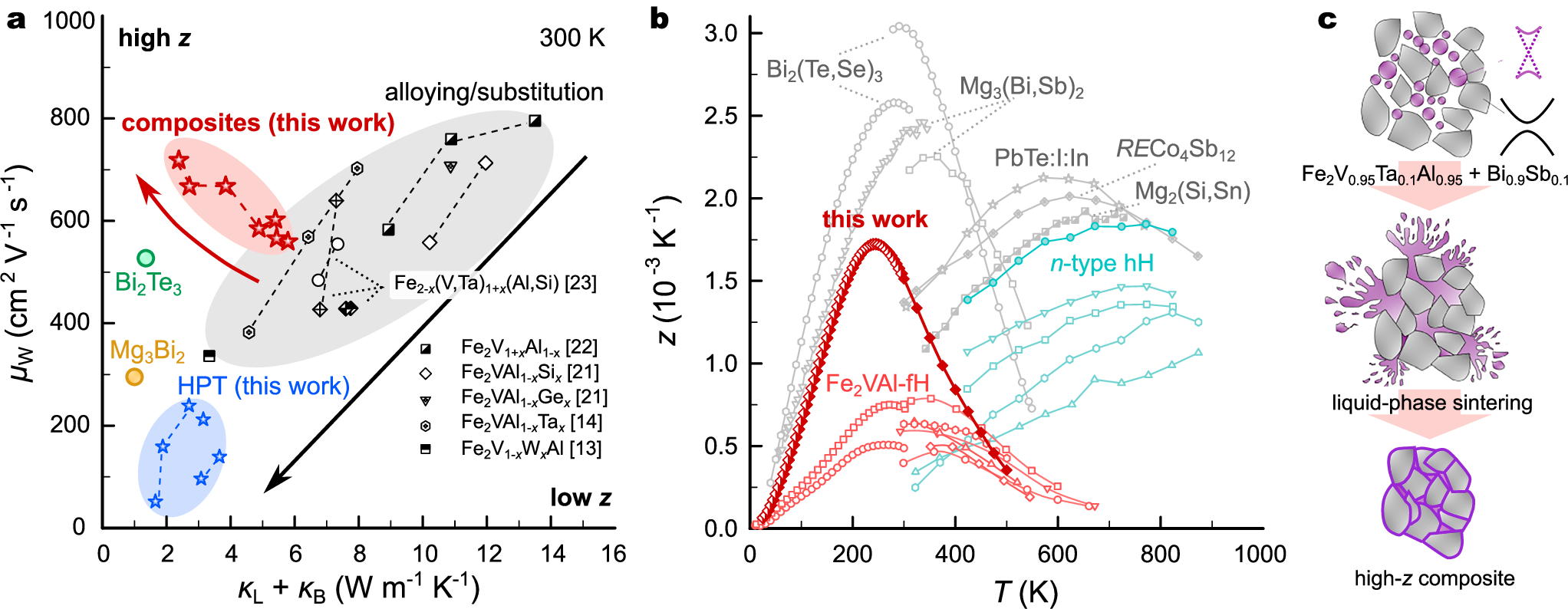
Decoupling charge and heat transport is essential for optimizing thermoelectric materials. Strategies to inhibit lattice-driven heat transport, however, also compromise carrier mobility, limiting the performance of most thermoelectrics, including Fe2VAl Heusler compounds. Here, we demonstrate an innovative approach, which bypasses this tradeoff: via liquid-phase sintering, we incorporate the archetypal topological insulator Bi1−xSbx between Fe2V0.95Ta0.1Al0.95 grains. Structural investigations alongside extensive thermoelectric and magneto-transport measurements reveal distinct modifications in the microstructure, a reduced lattice thermal conductivity and a simultaneously enhanced carrier mobility arising from topologically protected charge transport along the grain boundaries. This yields a huge performance boost, resulting in one of the highest figure of merits among both half- and full-Heusler compounds, z ≈ 1.6 × 10⁻³ K−1 (zT ≈ 0.5) at 295 K. Our findings highlight the potential of topological-insulating secondary phases to decouple charge and heat transport and call for more advanced theoretical studies of multiphase composites.