2025-07-15 日本原子力研究開発機構
<関連情報>
- https://www.jaea.go.jp/02/press2025/p25071501/
- https://pubs.aip.org/aip/jcp/article-abstract/162/24/244508/3350913/Specific-heat-anomalies-and-local-symmetry
(反)蛍石材料における比熱異常と局所対称性の破れ:機械学習分子動力学研究
Specific heat anomalies and local symmetry breaking in (anti-)fluorite materials: A machine learning molecular dynamics study
Keita KobayashiCorresponding Author;Hiroki Nakamura;Masahiko Okumura;Mitsuhiro Itakura;Masahiko Machida
The Journal of Chemical Physics Published:June 27 2025
DOI:https://doi.org/10.1063/5.0262059
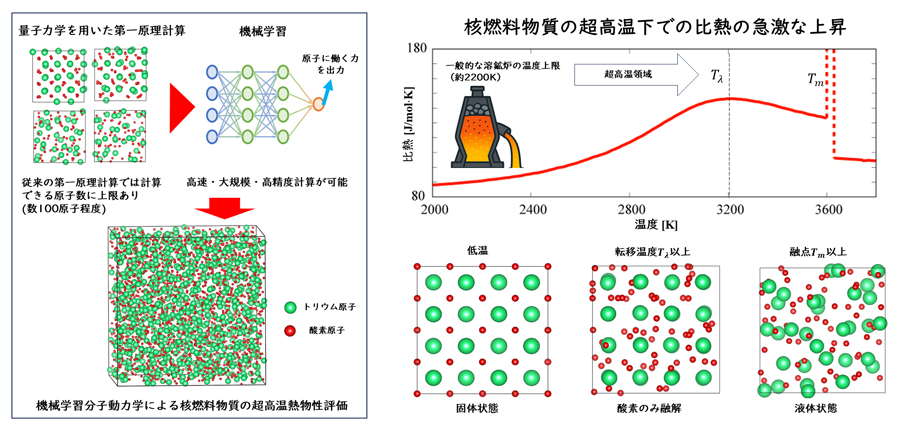
Understanding the high-temperature properties of materials with (anti-)fluorite structures is crucial for their application in nuclear reactors. In this study, we employ machine learning molecular dynamics (MLMD) simulations to investigate the high-temperature thermal properties of thorium dioxide, which has a fluorite structure, and lithium oxide, which has an anti-fluorite structure. Our results show that MLMD simulations effectively reproduce the reported thermal properties of these materials. A central focus of this work is the analysis of specific heat anomalies in these materials at high temperatures, commonly referred to as Bredig, pre-melting, or λ-transitions. We demonstrate that a local order parameter, analogous to those used to describe liquid–liquid transitions in supercooled water and liquid silica, can effectively characterize these specific heat anomalies. The local order parameter identifies two distinct types of defective structures: lattice defect-like and liquid-like local structures. Above the transition temperature, liquid-like local structures predominate and the sub-lattice character of mobile atoms disappears.