2026-11-19 カリフォルニア大学サンタクルーズ校(UCSC)
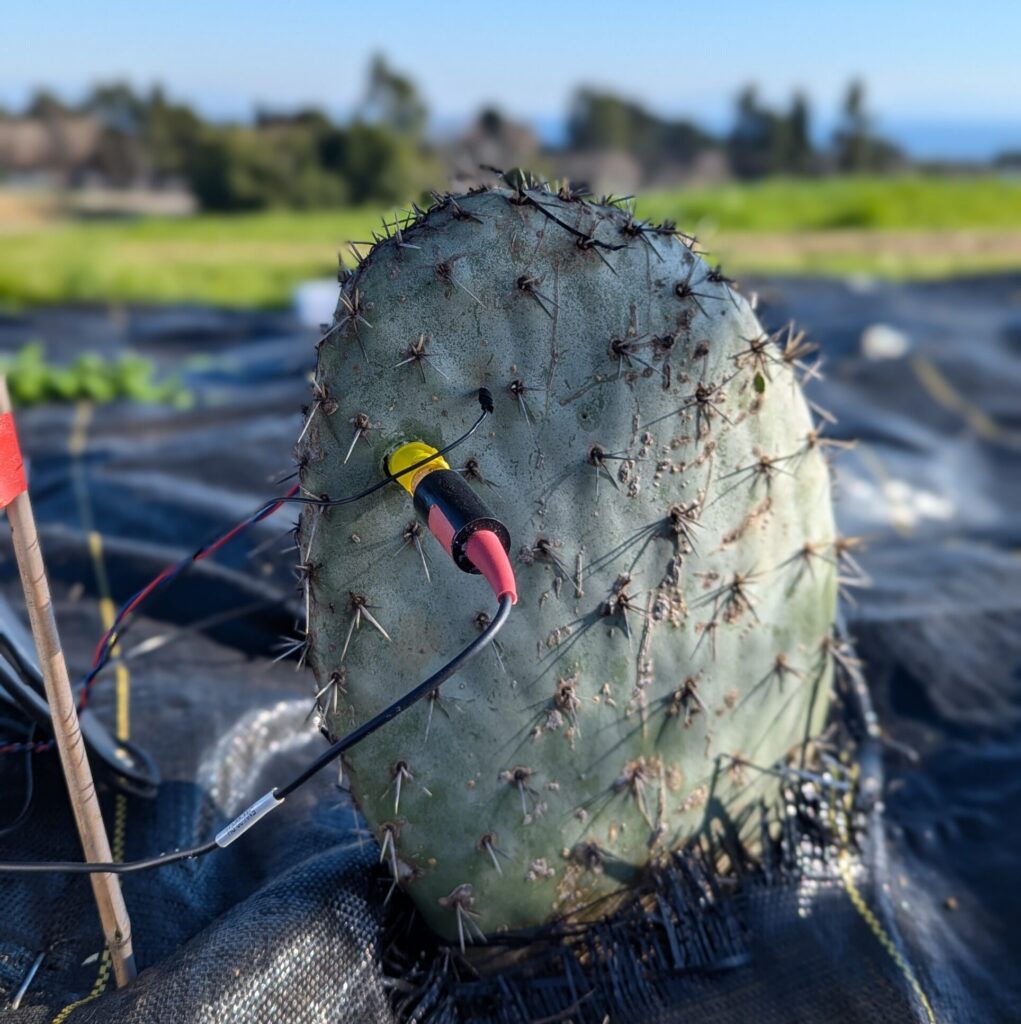
A prickly pear cactus stem is transformed into a living solar panel at UC Santa Cruz.
<関連情報>
- https://news.ucsc.edu/2026/11/researchers-harvest-electricity-from-prickly-pear-cacti/
- https://nph.onlinelibrary.wiley.com/doi/10.1002/ppp3.70295
生きた太陽光パネルからのエネルギー回収:ベンケイソウ型有機酸代謝(CAM)に関連する濃度勾配がサボテンの発電を駆動する
Power harvesting from living solar panels: Crassulacean acid metabolism-related concentration gradients drive cactus-produced electricity
Charlie M. Chesney, Joe Zheng, Erin Langness, Angelina Powers, Kai Ando, Ben Walker-Edwards, Sahithi Adiraju, Miles Johnson, Evelyn Cooper, Michael E. Loik
Plants, People, Planet(2026年11月19日オンライン先行公開), pp. 1–15.
DOI:https://doi.org/10.1002/ppp3.70295
植物が発電する仕組みを利用し、農業用センサーなどに電力を供給する新しいエネルギー回収技術が提案された。研究チームは、乾燥に強いベンケイソウ型有機酸代謝(CAM)を行うウチワサボテン(Opuntia streptacantha)を対象に、茎の両側に生じる電位差と光環境、光合成活性、水分状態との関係を調べた。その結果、日光を受ける側と陰になる側で光合成活性や有機酸濃度に差が生じ、これに伴う水素イオン濃度の勾配が電圧発生の主要な要因であることが示された。夏季の最大電圧は約60.2 mVで、冬季の約11.1 mVを大きく上回った。また、15か月間の乾燥処理後も、電圧や電力の発生は多くの光条件で有意に低下しなかった。一方、茎の水分含量は発電量に明確な影響を及ぼさなかった。これらの結果は、サボテンの電位変化を利用した植物の状態監視や、乾燥地域での低消費電力センサー向け電源の可能性を示している。ただし、実用的な電力供給には発電量の拡大や安定化など、さらなる技術開発が必要である。
This study proposes a new energy-harvesting approach that uses electricity generated naturally by plants to power agricultural sensors. The researchers investigated the relationship between electrical potential, light conditions, photosynthetic activity, and water status in Opuntia streptacantha, a prickly pear cactus that uses crassulacean acid metabolism (CAM). They found that differences in light exposure between the sun-facing and shaded sides of the cactus stem produce differences in photosynthetic activity and organic acid concentrations. The resulting hydrogen-ion concentration gradients were identified as a major driver of voltage generation. Maximum voltage was approximately 60.2 mV in summer, substantially higher than the 11.1 mV recorded in winter. Moreover, voltage and power production did not significantly decline under most light conditions even after 15 months of drought treatment. Stem water content, by contrast, had no clear effect on electricity generation. These findings suggest potential applications in plant-condition monitoring and as a drought-resilient energy source for low-power sensors, particularly in arid agricultural environments. However, further development is required to increase and stabilize the electrical output before practical deployment.
原著論文:Wiley Online Library