2026-11-19 合肥物質科学研究院(HFIPS)
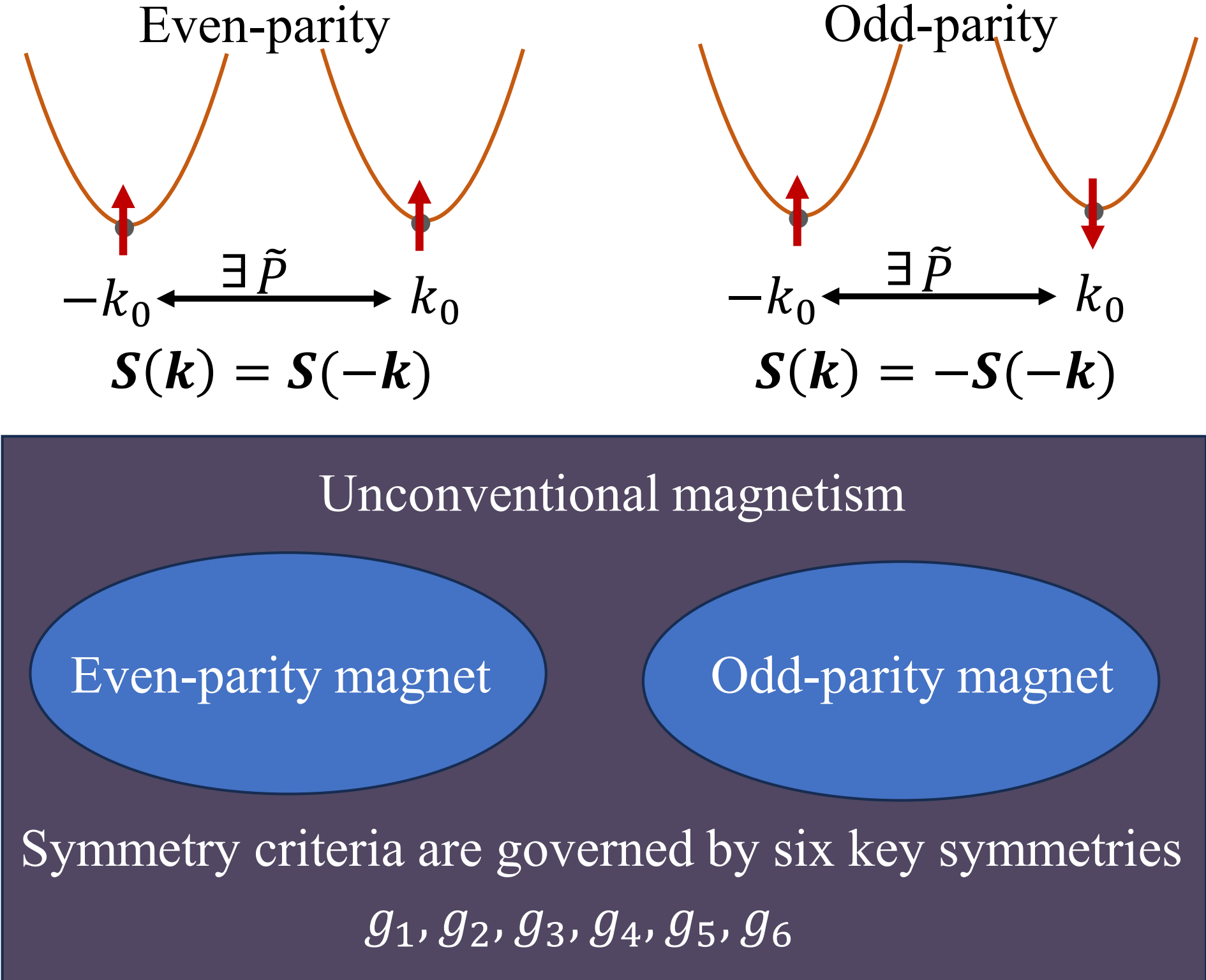
Unconventional magnetism falls into two classes, even-parity magnets and odd-parity magnets, whose symmetry criteria are governed by six key spin-group symmetries, g1-g6. (Image by LUO Xunjiang)
<関連情報>
- https://english.hf.cas.cn/nr/rn/202611/t20261119_1219807.html
- https://www.cell.com/newton/abstract/S2950-6360(26)00337-3
異例磁性体のためのスピン群対称性判定基準(Spin group symmetry criteria for unconventional magnetism)
Xun-Jiang Luo¹˒²˒⁴, Jin-Xin Hu², Mengli Hu³, Kam Tuen Law²
Newton Article 100735(2026)2026-11-12
DOI:10.1016/j.newton.2026.100735
本研究は、反強磁性体のように全体の磁化が相殺されながら、強磁性体のような電子のスピン分裂を示す異例磁性体(Unconventional Magnets)について、スピン空間群(Spin Space Group:SSG)に基づく統一的な対称性判定基準を確立した理論研究である。従来、運動量反転に対して対称な偶パリティ磁性体(EPM)と反対称な奇パリティ磁性体(OPM)は、それぞれ独立した経験則で分類されていた。研究チームは、運動量を保存する対称操作と反転する対称操作から6つの重要な対称操作を抽出し、その有無によってスピンテクスチャの共線型・共面型・非共面型という3種類の特徴と、スピン分裂の偶奇性を必要十分条件で判定する枠組みを構築した。この基準により、6種類のスピン分裂と15種類の対称性に基づく発現機構を体系化した。さらに、奇パリティ磁性体には共面磁気秩序や時間反転・並進対称性が必須ではないこと、共面磁性体でもアルターマグネットとは異なる機構で共線型の偶パリティスピン分裂が生じることを明らかにした。MAGNDATAデータベースの解析では、既知のアルターマグネットを除き、奇パリティ磁性体33種類、偶パリティ磁性体60種類の候補を特定した。また、奇パリティ磁性体の理論モデルで保護された螺旋端状態が存在し得ることを示した。本成果は、異例磁性体の体系的な理解と新規磁性材料の探索・設計を促進し、次世代スピントロニクスやトポロジカル量子物性の研究に貢献するものである。
This theoretical study establishes a unified symmetry framework for classifying unconventional magnets, which exhibit compensated magnetization similar to antiferromagnets while retaining ferromagnet-like electronic spin splitting. Previously, even-parity magnets (EPMs), whose spin splitting is symmetric under momentum inversion, and odd-parity magnets (OPMs), whose spin splitting is antisymmetric, were classified using separate empirical rules. The researchers developed a systematic approach based on spin space groups (SSGs), identifying six key symmetry operations associated with momentum-preserving and momentum-reversing transformations. The presence or absence of these operations provides necessary and sufficient criteria for determining both the spin-texture dimensionality—collinear, coplanar, or noncoplanar—and the parity of spin splitting. This framework establishes a comprehensive taxonomy comprising six types of spin splitting and fifteen distinct symmetry-driven mechanisms. It also challenges established paradigms by demonstrating that odd-parity magnets do not necessarily require coplanar magnetic order or time-reversal-translation symmetry. Furthermore, coplanar magnetic structures can exhibit collinear even-parity spin splitting through a mechanism fundamentally different from altermagnetism. Applying the criteria to the MAGNDATA database, the researchers identified 33 candidate odd-parity magnets and 60 candidate even-parity magnets, excluding known altermagnets. They also developed a theoretical model demonstrating that odd-parity magnets can support protected helical edge states. These findings provide a systematic foundation for understanding, predicting, and designing unconventional magnetic materials, with potential implications for next-generation spintronics and topological quantum phenomena.
原著論文:Cell Press – Newton