

2026-11-18 エディンバラ大学
<関連情報>
- https://www.ed.ac.uk/news/easy-clean-surfaces-could-improve-solar-panels
- https://www.science.org/doi/10.1126/sciadv.aef8434
液滴によって粒子が除去される条件とメカニズム(When and how particles are removed by drops)
Abhinav Naga, Franziska Sabath, Doris Vollmer, Halim Kusumaatmaja
Science Advances, Volume 12, Issue 46, Article eaef8434 2026-11-13
DOI:10.1126/sciadv.aef8434

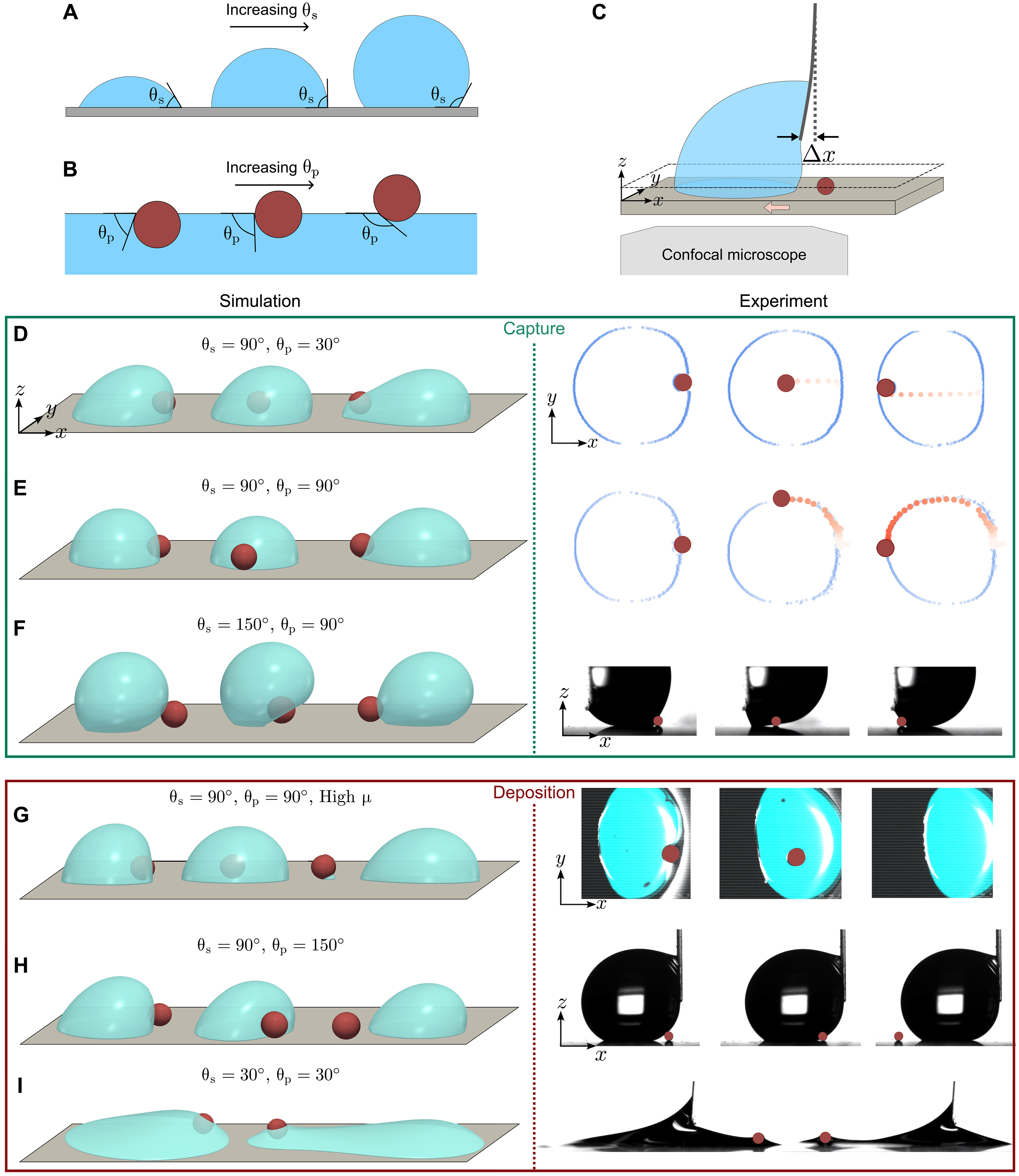
Fig. 1. Drop-particle interaction scenarios.
(A) Schematic of the equilibrium shape of a drop as a function of the surface contact angle θs. (B) Schematic of equilibrium position of a particle at a liquid-air interface as a function of the particle contact angle θp. (C) Experimental setup to image drop-particle interaction and to measure horizontal forces. (D to F) Interaction scenarios when the particle is captured by drop. (G to I) Interaction scenarios when the particle is redeposited by the drop. In (D) to (I), left and right columns show simulations and experiments, respectively. In the simulations, the particle diameter was 200 μm. Values of θp and θs listed for the simulations correspond to static contact angles. In the experiments, the particle diameter is in the range 210 to 250 μm, except in (I) where it is between 355 and 420 μm. In the experiments, θp ranges from 20° to 145° and θs ranges from <30° to 150°. See Table 1 for further experimental details. Right column of (G) is reproduced from Naga et al. (33) under a Creative Commons CC BY 3.0 license (https://creativecommons.org/licenses/by/3.0/).
To clarify how droplets remove particulate contaminants from surfaces, a process relevant to solar panels, windows, and precision electronic devices, the researchers combined lattice Boltzmann–discrete element simulations with confocal microscopy experiments. They identified six distinct interaction scenarios when a droplet collides with a particle, including cases in which the particle is captured by the droplet and cases in which it remains on the surface. Particle removal depends not only on capillary forces exerted by the droplet but also on friction between the particle and the substrate. The vertical component of the capillary force can either promote removal by lifting the particle or hinder it by pressing the particle against the surface. The researchers further introduced a dimensionless capillary capture parameter that incorporates particle wettability, surface wettability, and friction, successfully predicting particle removal across a broad range of conditions. The findings indicate that designing self-cleaning surfaces requires not only high water repellency but also reduced friction between particles and surfaces, providing a quantitative basis for developing surfaces that can be cleaned naturally by raindrops.

