2026-11-11 中国科学院(CAS)
中国科学院分子植物科学卓越イノベーションセンターの趙代胤(CHAO Daiyin)氏らの研究グループは、トウモロコシにおける微量元素ニッケルの長距離輸送機構を解明し、穀粒へのニッケル蓄積を制御する輸送体遺伝子「ZmNAET1」を発見した。1,404系統のトウモロコシを対象としたゲノムワイド関連解析などにより、同遺伝子の発現量が高い系統では、穀粒中のニッケル濃度が約60%高いことを明らかにした。また、植物特有のアミノ酸であるニコチアナミン(NA)がニッケルと結合し、師管を介して穀粒などへ輸送する仕組みを解明した。ニッケル輸送は、尿素分解酵素ウレアーゼの活性を通じてアミノ酸代謝、穀粒の大きさやデンプン含量、収量、種子の発芽能力にも影響する。さらに、イネでも相同遺伝子OsNAET1、OsNAET2の機能を確認した。本成果は、微量元素の栄養管理と分子育種による穀物の収量・品質・種子活力の向上に新たな道を開くものである。
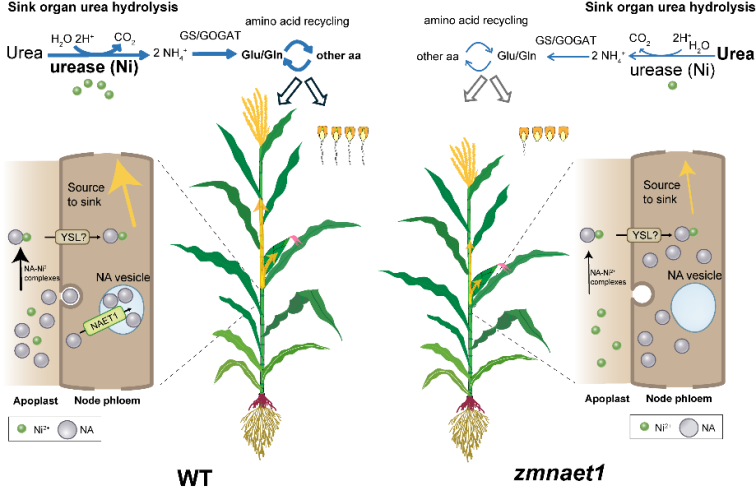
Model of how NA-mediated long-distance source-to-sink nickel transport regulates maize yield and seed vigor. (Image by CHAO Daiyin’s group)
<関連情報>
ニコチアナミンを介したニッケルのシンク器官への輸送がトウモロコシの生産性を支える
Nicotianamine-driven nickel transport to sink organs underpins maize productivity
Zhen-Fei Chao ∙ Yuanyuan Chen ∙ Jia-Chen Wu ∙ … ∙ Nicolaus von Wirén ∙ Jianbing Yan ∙ Dai-Yin Chao
Cell Published:November 10, 2026
DOI:https://doi.org/10.1016/j.cell.2026.10.035
Tii-summary
植物に必須の微量元素であるニッケル(Ni)は、尿素分解酵素ウレアーゼの活性に不可欠であるが、植物体内での長距離輸送機構や穀物生産における役割は十分に解明されていなかった。本研究では、1,404系統のトウモロコシを用いたゲノムワイド関連解析などにより、穀粒へのニッケル輸送を制御する輸送体遺伝子ZmNAET1を特定した。同遺伝子は植物特有の非タンパク質アミノ酸ニコチアナミン(NA)の細胞外への分泌を促進し、NAがニッケルと結合することで、師管を介した茎節から穀粒などのシンク器官への長距離輸送を可能にする。ZmNAET1の機能を欠損させると、穂重や粒の大きさ、デンプン蓄積が低下し、種子の発芽速度や貯蔵後の寿命も著しく損なわれた。一方、ニッケルを補給すると発芽や栄養成長が回復した。さらに、イネでも相同遺伝子OsNAET1、OsNAET2の機能が確認された。本成果は、禾本科作物におけるニッケルの必須性と輸送機構を遺伝学的に明らかにし、微量元素の栄養管理や分子育種による穀物の収量・品質・種子活力の向上に新たな道を開くものである。
Nickel (Ni) is an essential micronutrient in plants and is required for urease activity, but its long-distance transport mechanisms and contribution to cereal productivity have remained poorly understood. In this study, genome-wide association analysis of 1,404 maize lines identified ZmNAET1 as a key transporter controlling nickel allocation to grains. ZmNAET1 promotes the secretion of nicotianamine (NA), a plant-specific non-proteinogenic amino acid. NA binds nickel extracellularly, facilitating its long-distance transport through the phloem from stem nodes to sink organs, including developing grains. Loss of ZmNAET1 function resulted in reduced ear weight, smaller grains, decreased starch accumulation, slower seed germination, and substantially shortened seed longevity during storage. Nickel supplementation rescued seed germination and normal vegetative development in the mutants. The researchers also identified two homologous genes, OsNAET1 and OsNAET2, in rice, suggesting that this transport mechanism is conserved among cereal crops. These findings provide genetic evidence for the essential role of nickel in grasses and reveal a previously unrecognized mechanism of micronutrient allocation. The study opens new opportunities to improve cereal yield, grain quality, and seed vigor through micronutrient management and molecular breeding.
出典:Cell(2026年11月10日公開)、出版社掲載情報および論文抄録。