2026-11-11 水産研究・教育機構
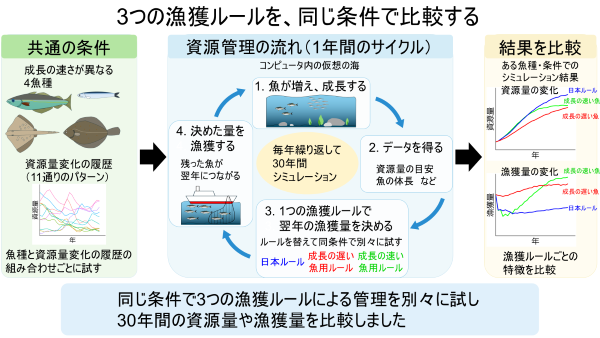
図 「日本とヨーロッパの漁獲ルールを比較する方法」
4魚種と11通りの資源量変化の履歴を想定し、同じ条件で3つの漁獲ルールを別々に30年間シミュレーションしました。
魚の増減、データの取得、漁獲量の決定、漁獲を毎年繰り返し、資源量と漁獲量を比較しました。
<関連情報>
- https://www.fra.go.jp/home/kenkyushokai/ronbun/2026/20261111_2.html
- https://academic.oup.com/icesjms/article/83/10/fsag198/8868267
同一の運用モデル下における、制度的に異なる経験的収穫管理規則の対照的なパフォーマンス Contrasting performance of institutionally distinct empirical harvest control rules under identical operating models
Tatsunori Yagi , Momoko Ichinokawa
ICES Journal of Marine Science Published: 06 October 2026
DOI:https://doi.org/10.1093/icesjms/fsag198
Abstract
Most global fish stocks are data-limited, lacking adequate catch, survey, and biological data to estimate stock status with a population dynamics model. Empirical harvest control rules (HCRs) are the most widely implemented of the various data-limited approaches, calculating advised catch directly from observed data. The rfb rule and the chr rule in Europe and the type-2 rule in Japan are representative examples. While these rules have been developed using population and fisheries dynamics simulations (operating models, OMs) within independently constructed management strategy evaluation (MSE) frameworks, this study directly compares the three HCRs and two modified HCRs under identical OM settings across 11 fishing histories and four life-history parameter sets over a 30-year management period. We examined the robustness of (i) the characteristics of each HCR, (ii) their relative performance, and (iii) the tuning parameters optimized with a genetic algorithm, against differences in OM structure. With default parameters, the type-2 rule yielded lower catches with more rapid recovery, whereas the rfb rule produced higher catches with more gradual recovery. The chr rule transitioned from type-2-like performance in the short term to rfb-like higher catches in the longer term. These contrasts in performance can be understood in light of each rule’s management context, given that each satisfies its own management objective across a wide range of uncertainties. Almost all optimal empirical HCRs achieved higher long-term catches than those with default parameters, confirming the importance of stock-specific conditioning. The rfb rule was more robust to fishing histories than the type-2 rule and the chr rule, possibly reflecting the additional information on stock status provided by catch length data in the rfb rule. The results for the rfb rule also showed that the relative importance of its structural components depends on species characteristics. These findings can be organized along three key dimensions: the information used, species-specific life-history characteristics, and the management objectives and ranges of uncertainty. Framing HCR design along these dimensions provides a useful perspective for developing general and flexible empirical HCRs that can be applied to new data-limited stocks beyond the specific institutional context in which each rule was originally developed.