2026-11-10 産業技術総合研究所
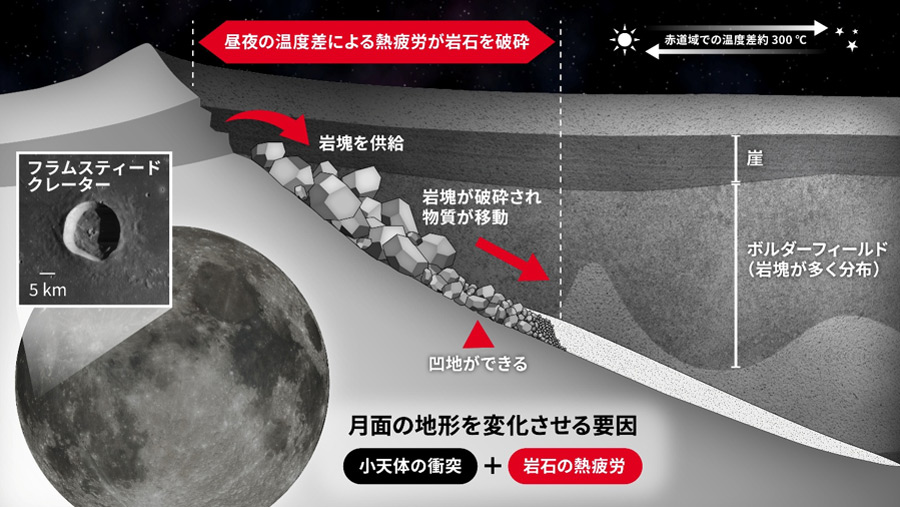
産業技術総合研究所の研究チームは、月のフラムスティードクレーター内壁斜面を対象に、月周回衛星「かぐや」とNASAの月周回探査機LROの観測データを統合解析し、微地形と岩塊分布の関係を明らかにした。解析の結果、斜面中腹に存在する数百メートル規模の凹地と、岩塊が密集する領域がおおむね一致することを発見した。さらに、岩塊の供給・破砕・移動を考慮した地形変化モデルを構築し、現在の岩塊分布を維持するために必要な供給量を推定した。その量は天体衝突による岩塊供給の推定値を約2桁上回り、衝突だけでは説明できないことが判明した。この結果から、月面の昼夜の大きな温度差によって岩石の膨張・収縮が繰り返される熱疲労が、岩石の破砕や岩塊供給、斜面の物質移動に寄与している可能性が示された。月や小惑星など、大気や水の乏しい岩石天体の表面進化を理解する手がかりとなる。
<関連情報>
- https://www.aist.go.jp/aist_j/press_release/pr2026/pr20261110/pr20261110.html
- https://www.sciencedirect.com/science/article/abs/pii/S0032063326001145
岩石量に関連した月面クレーター斜面の微地形の特徴付け:フラムスティード・クレーターにおける事例研究 Characterization of microtopography of lunar crater slopes related to rock abundance: A case study at Flamsteed crater
Ayame Ikeda,Hiroyuki Kumagai,Tomokatsu Morota
Planetary and Space Science Available online: 11 September 2026
DOI:https://doi.org/10.1016/j.pss.2026.106347
Highlights
- We found microtopography with bulges and depressions on Flamsteed crater walls.
- The microtopography was related to rock abundance on inner crater slopes.
- Thermal fatigue accounts for rock fragmentation to form the microtopography.
Abstract
Complex topographic features on crater slopes recently revealed by lunar orbiter explorations suggest the existence of rapid mass-wasting phenomena, and their contribution to long-term crater degradation remains poorly understood. We investigated Flamsteed crater, where regions of large rock abundance (RA) derived from the Lunar Reconnaissance Orbiter Diviner Radiometer are widely exposed. We found that large RA regions corresponded to densely distributed boulders (boulder fields) with large contents of FeO and TiO2 that were heterogeneously distributed in the northern to southwestern slopes. There are horizontally layered cliffs in upslope positions above boulder fields. Topographic profiles estimated from digital terrain model data showed microtopographic features characterized by bulges and depressions with undulations of 10−20 m in the southwestern slope, and depression locations roughly coincided with RA peak positions. We found that the amounts of depressions increased with increasing RA. Based on these results, we considered that boulders supplied from cliffs formed boulder fields and that the boulders have been gradually fragmented into small pieces and regolith. We developed a model to explain the formation of boulder fields by fragmented rocks supplied from cliffs, and estimated the boulder supply rate to be 0.7 × 10³ m3/Myr. This estimate was two orders of magnitude larger than that expected from fracturing of a rock layer by meteorite impacts, and such rapid processes required weakening and fracturing due to thermal fatigue. We propose that RA is related to the microtopography of crater slopes and that thermal fatigue plays an important role in rock fragmentation.