2026-11-10 ロッキーズ国立研究所(NLR)
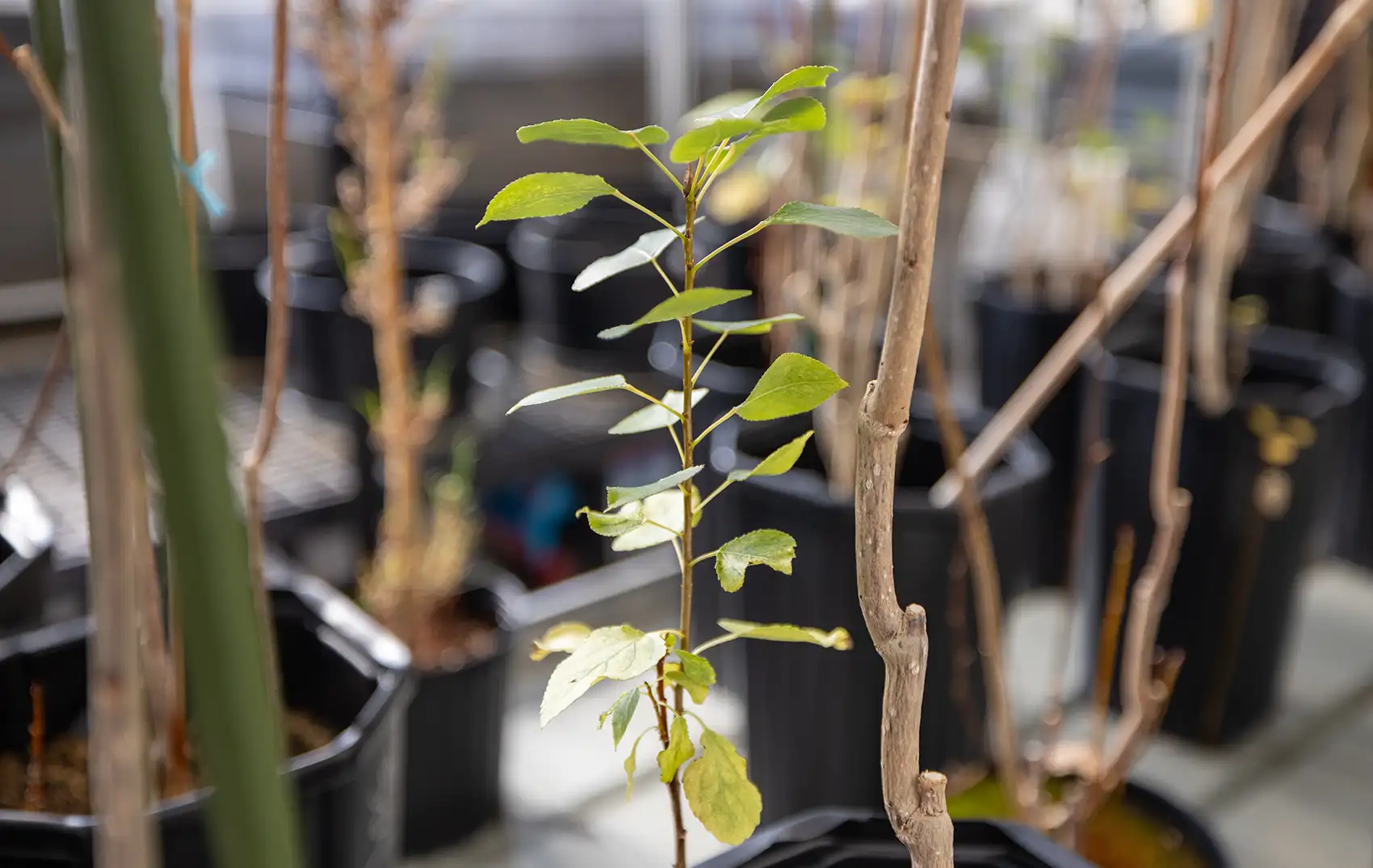
NLR scientists spent six weeks growing 13 poplar genotypes in a carbon 13-enriched environment to prepare them for atomic-level ssNMR experimentation. Photo by Gregory Cooper, National Laboratory of the Rockies
<関連情報>
- https://www.nlr.gov/news/detail/program/2026/researchers-at-national-laboratory-of-the-rockies-uncover-natural-design-laws-that-shape-tree-cell-walls
- https://www.nature.com/articles/s41467-026-75007-7
固体核磁気共鳴(ssNMR)と原子論的モデリングによって明らかになった、ポプラ二次細胞壁の保存された高分子構造 Conserved macromolecular architecture of poplar secondary cell walls revealed by ssNMR and atomistic modeling
Bennett Addison, Malitha C. Dickwella Widanage, Meagan F. Crowley, Vivek S. Bharadwaj, Lintao Bu, Michael F. Crowley, Anne E. Harman-Ware & Peter N. Ciesielski
Nature Communications Published:02 July 2026
DOI:https://doi.org/10.1038/s41467-026-75007-7
Abstract
The macromolecular architecture of plant secondary cell walls governs wood’s mechanical and biochemical properties, yet its natural intra-species variability remains poorly characterized. Here, we combined ¹³C solid-state NMR (ssNMR), multivariate statistical analysis, and molecular modeling to profile nanoscale structure across 13 genetically diverse Populus trichocarpa genotypes grown in ¹³C-enriched atmospheres. SsNMR-derived phenotypes spanning composition, structure, mobility, and inter-polymer proximities reveal a conserved architecture, with a subtle yet coordinated variation organizing into dominant structural and secondary mobility axes. A representative atomistic model captures these features and reproduces experimental metrics. Molecular dynamics simulations support a weak but consistent positive correlation between cellulose abundance and crystalline-like order, with interior cellulose chains enriched in tg (trans–gauche) conformations without expanding crystalline cores. Together, experiment and simulation reveal a genetically buffered, broadly conserved nanoscale architecture across genotypes, where subtle fine-tuning of cellulose bundling and matrix packing balances mechanical performance with biological function.