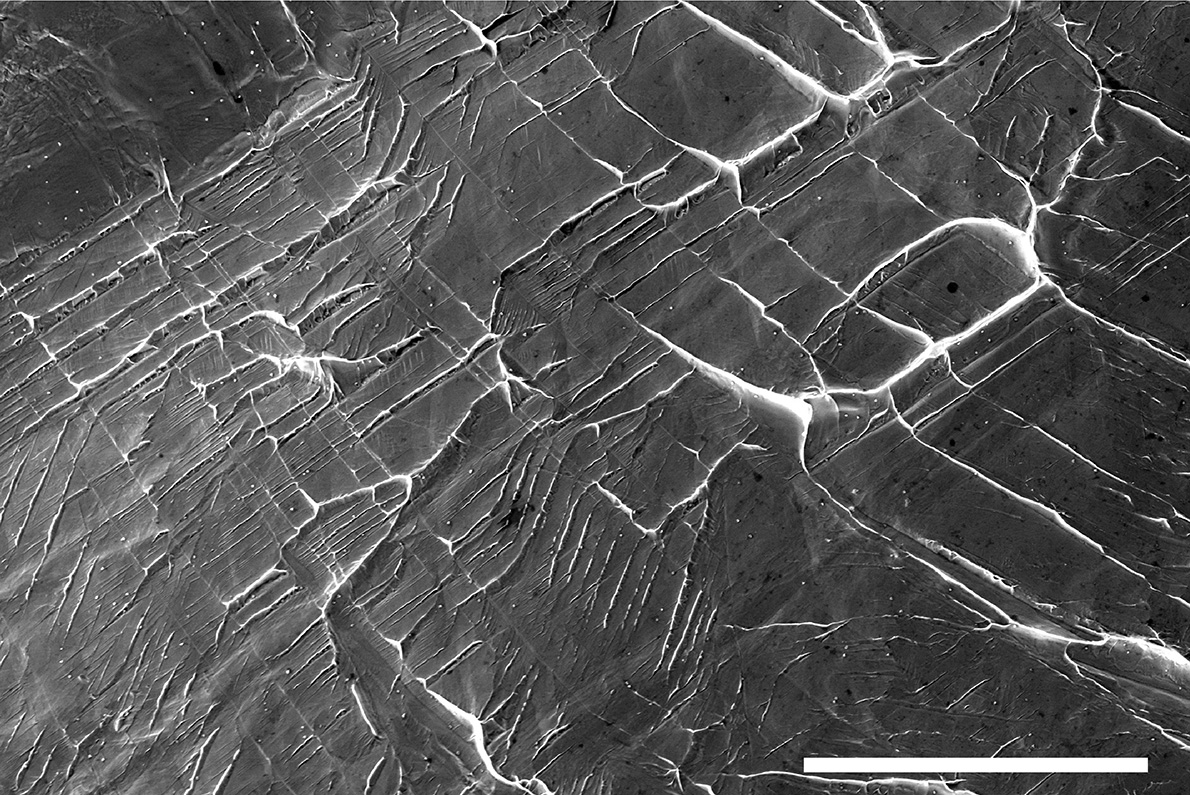
2026-11-10 ペンシルベニア州立大学(Penn State)
<関連情報>
- https://www.psu.edu/news/earth-and-mineral-sciences/story/bennu-asteroid-analysis-suggests-unexpected-origins-organics-space
- https://www.nature.com/articles/s43247-026-04084-9
- https://www.pnas.org/doi/10.1073/pnas.2517723123
小惑星ベンヌとマーチソン隕石の試料中のβ-アラニンの窒素および分子内炭素同位体測定 Nitrogen and intramolecular carbon isotopic measurements of β-alanine in samples from asteroid Bennu and the Murchison meteorite
Ophélie M. Mcintosh, Allison A. Baczynski, Cornelia Rasmussen, David W. Hoffman, Daniel P. Glavin, Jason P. Dworkin, Jamie E. Elsila, Christopher H. House, Katherine H. Freeman, Harold C. Connolly Jr & Dante S. Lauretta
Communications Earth & Environment Published:24 September 2026
DOI:https://doi.org/10.1038/s43247-026-04084-9 Early provide
Abstract
Amino acids are central to prebiotic chemistry, and their abundances and isotopic compositions provide critical constraints on the synthetic mechanisms and environments in which they formed. Samples delivered to Earth from the carbonaceous asteroid (101955) Bennu by NASA’s OSIRIS-REx mission offer an opportunity to investigate amino acids preserved in pristine material unaffected by terrestrial contamination. Here, we report δ15N and δ13C intramolecular isotopic measurements for β-alaninein a homogenized regolith from Bennu (δ13COOH = 363 ± 29‰; δ13Cα + β = −163 ± 13‰; δ15N = 170 ± 4‰) and the Murchison meteorite (δ13COOH = 111 ± 22‰; δ13Cα + β = −44 ± 10‰; δ15N = 63 ± 4‰). Large intramolecular isotopic differences between the COOH and the position-averaged Cα + β carbons were measured in both samples (Δ= 526 ± 32‰ and 155 ± 24‰, respectively). The samples display similar intramolecular isotope distributions, consistent with a common synthetic route, but differ markedly in their position-specific carbon and nitrogen isotope compositions (Δδ13COOH = 252 ± 36‰, Δδ13Cα + β = 119 ± 16‰, Δδ15N = 107 ± 6‰). These differences are difficult to reconcile with recognized parent-body processes and suggest that nitrogen and intramolecular carbon isotopic measurements could provide direct geochemical evidence for spatial heterogeneity in organic synthesis across the protoplanetary disk and new constraints on the chemical environments and precursor reservoirs that gave rise to extraterrestrial amino acids.
小惑星ベンヌの試料中の炭素および窒素同位体に基づく、初期太陽系におけるアミノ酸の複数の形成経路 Multiple formation pathways for amino acids in the early Solar System based on carbon and nitrogen isotopes in asteroid Bennu samples
Allison A. Baczynski, Ophélie M. Mcintosh, Danielle N. Simkus, +8 , and Dante S. Lauretta
Proceedings of the National Academy of Sciences Published:February 9, 2026
DOI:https://doi.org/10.1073/pnas.2517723123

Abstract
Samples collected from the carbonaceous near-Earth asteroid Bennu and delivered to Earth by NASA’s OSIRIS-REx mission contain organic molecules relevant to prebiotic chemistry. Stable isotopic measurements of extraterrestrial soluble organic matter provide critical insights into the formation pathways and alteration histories of such molecules, which hold significance for understanding the origins of life. We leverage state-of-the-art techniques for picomolar-scale isotopic analyses of amino acids in samples of Bennu and, for comparison, the carbonaceous meteorite Murchison. We report intramolecular δ13C values for glycine, which have not previously been measured in extraterrestrial materials; molecular-averaged δ13C values for amino acids, aldehydes, and ketones; and δ15N values for glycine, β-alanine, and D/L-glutamic acid. Intramolecular carbon isotope patterns of glycine in Bennu contrast with those in Murchison, suggesting distinct formation pathways. We explore several formation mechanisms and hypothesize that the observed glycine in Murchison formed dominantly by a Strecker-like synthesis under aqueous conditions, whereas the glycine currently found in Bennu may have formed mainly by modified radical–radical reactions in primordial ices at the cold, outer reaches of the early Solar System and retained its isotopic values throughout accretion and multiple episodes of aqueous alteration. This hypothesis is supported by the highly 15N-enriched δ15N values in Bennu amino acids (+170 to 277‰). Differences in the δ15N values of D- and L-glutamic acid (Δ = 87‰) in Bennu affirm published reports of enantiomeric differences in meteoritic amino acids and challenge the assumption of isotopic uniformity between amino acid chiral pairs.