2026-11-05 東北大学
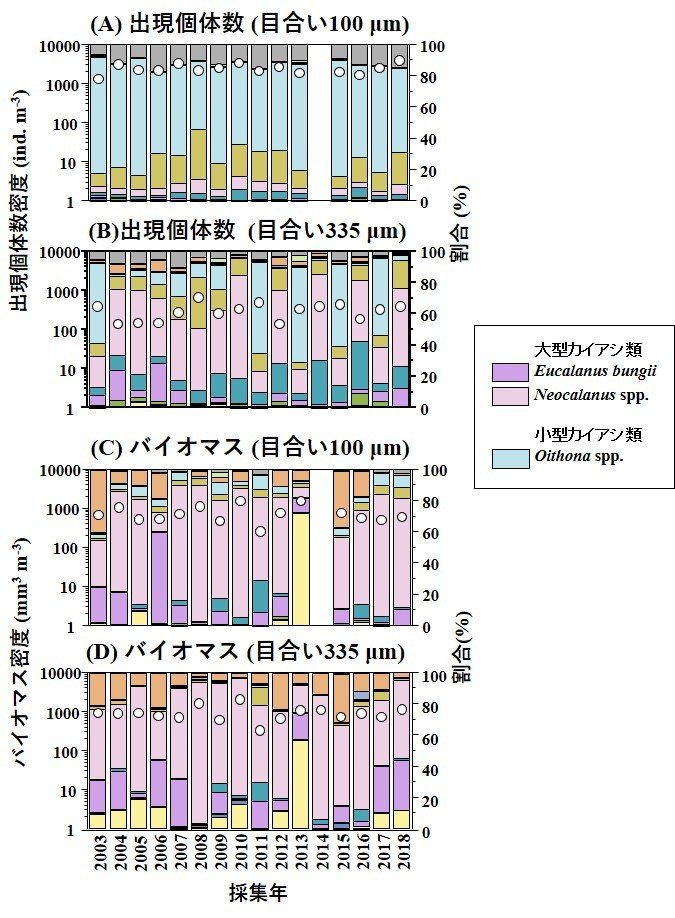
図1. 2003~2018年の春季の、西部北太平洋亜寒帯域における動物プランクトン出現個体数(A: 目合い100 µm、B: 目合い335 µm)とバイオマス(C: 目合い100 µm、D: 目合い335 µm)。バイオマスでは目合いによる差が小さいが、出現個体数においては小型な目合い(100 µm)の方が高く、特に小型カイアシ類のOithona属の占有率が高くなっている。
<関連情報>
- https://www.tohoku.ac.jp/japanese/2026/11/press20261105-03-zooplankton.html
- https://www.mdpi.com/2673-1924/7/6/89
西太平洋亜寒帯の観測地点における春季(2003~2018年)の表層動物プランクトン群集とサイズ構成の年々変動:網目サイズの違いの影響 Interannual Variations in Epipelagic Zooplankton Communities and Size Composition at a Station in the Western Subarctic Pacific During Spring (2003–2018): Influence of Mesh Size Differences
Wataru Obi,Sojin Ryu,Kazuki Maeda,Muhammad Izzat Nugraha,Kosei Sasaoka,Goh Nishitani and Atsushi Yamaguchi
Oceans Published: 22 October 2026
DOI:https://doi.org/10.3390/oceans7060089
Abstract
In the western subarctic Pacific, zooplankton biomass is dominated by large copepods such as Neocalanus spp. and Eucalanus bungii, whereas small copepods dominate numerically. To evaluate how mesh size affects long-term monitoring, zooplankton were collected from 0 to 150 m with 100 µm and 335 µm mesh nets in mid-May of 2003–2018 and analyzed by ZooScan imaging. Abundance in the 335 µm net was only 11.7% of that in the 100 µm net, and the numerically dominant taxon shifted from Oithona spp. to Neocalanus spp. Total biovolume differed little between the nets and was dominated by Neocalanus spp. in both. A regime shift, a decline in 2008, was detected in E. bungii with both nets, whereas no shift was detected in Neocalanus spp., consistent with their reproduction in the epipelagic layer and at depth, respectively. Mean body size of both species was larger in the 335 µm net, which does not retain the smallest individuals. Each mesh size therefore gives a more reliable estimate for the taxa it retains, and the two nets together separate biomass-related from abundance-related patterns.