

2026-09-29 ワシントン大学セントルイス校
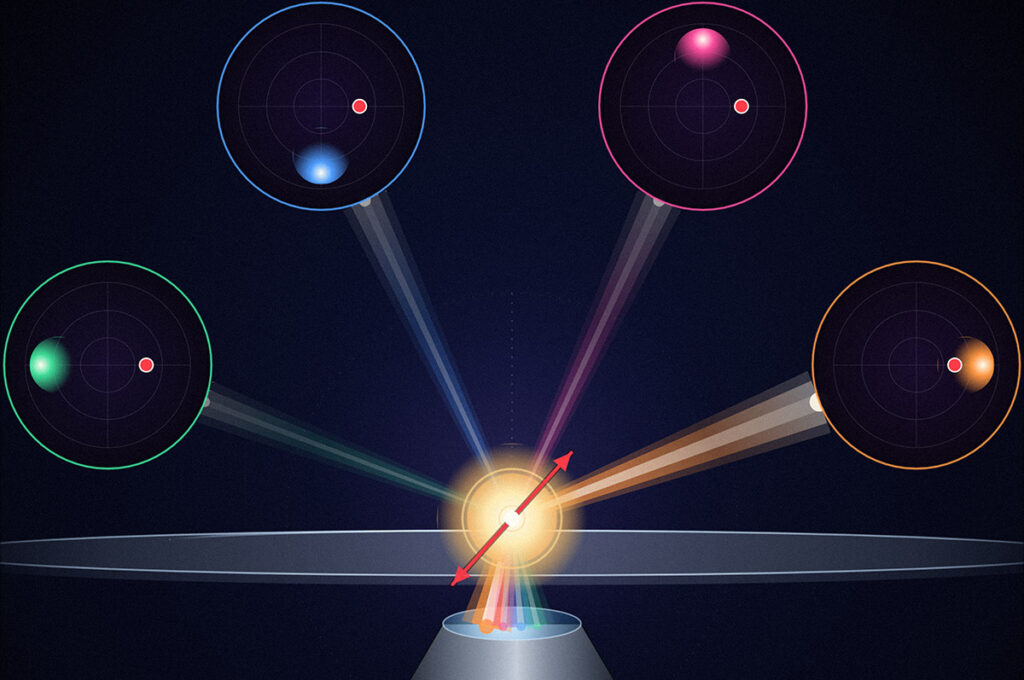
A single fluorophore sits on a glass coverslip, excited in sequence by four polarized beams optimized via a Fisher-information framework. This illustration visualizes the central finding of recent WashU research on single-molecule orientation-localization microscopy (SMOLM): how you illuminate a molecule matters as much as how you detect it. (Image: Kaizhi A. Nie via Claude Code)
<関連情報>
- https://source.washu.edu/2026/09/how-light-can-reveal-the-hidden-orientation-of-a-single-molecule/
- https://opg.optica.org/boe/fulltext.cfm?uri=boe-17-9-4854
単一分子配向イメージングの精度を高めるための最適な励起偏光スキーム Optimal excitation polarization schemes to boost the precision of single-molecule orientation imaging
Kaizhi A. Nie, Yuanxin Qiu, and Matthew D. Lew
Biomedical Optics Express Published: August 26, 2026
DOI:https://doi.org/10.1364/BOE.607950
Abstract
Modulating excitation polarization across camera frames can improve the precision of single-molecule orientation-localization microscopy (SMOLM), but principled methods for designing these excitation sequences remain underdeveloped. Here, we introduce a Fisher-information framework for optimizing linearly and circularly polarized excitation schemes under a fixed total illumination photon budget. For the multi-view reflector microscope, 3000 illumination photons, and 7.5 detected background photons per pixel, an optimized four-frame linear scheme improves median orientation measurement precision by 21.2% relative to the conventional six-frame equal-pumping scheme and achieves Cramér–Rao-bound-limited median precisions of óθ,50=2.59° and óθ,50=3.22° Increasing to six optimized linear frames provides only modest additional improvement, demonstrating that four frames offer an effective balance between precision, uniformity across molecular orientations, and temporal resolution. With only two frames, circularly polarized excitation yields more uniform performance and 27% better median precision than two-frame linear excitation, whereas linear schemes perform better with four or more frames. Applying the framework to four engineered dipole-spread functions shows that excitation sequences should be tailored to the detection system. These results provide practical strategies for balancing orientation precision, photon budget, and acquisition speed in SMOLM.

