2026-09-28 カリフォルニア大学リバーサイド校(UCR)
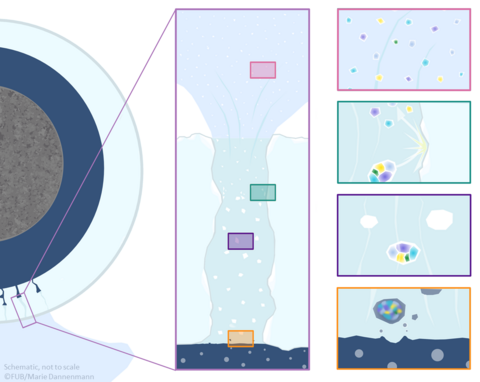
The study examined mass spectra of ice grains from Enceladus’s plume and found that the grains exhibit much greater compositional diversity than previously recognized, suggesting that plume formation is more complex than previously thought. This illustration shows the mechanism the authors propose: the plume forms through the slow freezing and fragmentation of oceanic spray originating from within the moon. (FUB/Marie Dannenmann)
<関連情報>
- https://news.ucr.edu/articles/2026/09/28/saturns-moon-offers-clues-search-extraterrestrial-life
- https://www.science.org/doi/10.1126/sciadv.aee7256
カッシーニCDAは、エンケラドゥスの氷粒が、ゆっくりとした凍結と海洋スプレーの破砕によって組成的に分離していることを観測した Cassini CDA observes compositional segregation of Enceladus’ ice grains from slow freezing and fragmentation of oceanic spray
Frank Postberg, Zenghui Zou, Yasuhito Sekine, Minori Koga, […] , and Ralf Srama
Science Advances Published:25 Sep 2026
DOI:https://doi.org/10.1126/sciadv.aee7256
Abstract
Salt-rich ice particles, termed Type 3, are a major compositional group within Enceladus’ plume and Saturn’s E ring and are thought to represent frozen micrometer-sized aerosolized droplets of Enceladus’ salty subsurface ocean. Here, we present an analysis on the basis of ≈1000 mass spectra of individual Type 3 E ring ice grains recorded by Cassini’s Cosmic Dust Analyzer (CDA), revealing a large compositional diversity among these grains. We find at least five basic compositional subtypes dominated by either sodium chloride (NaCl), sodium bicarbonate (NaHCO3)/sodium carbonate (Na2CO3), disodium phosphate (Na2HPO4)/trisodium phosphate (Na3PO4), sodium hydroxide (NaOH), potassium chloride (KCl), or potassium hydroxide (KOH). By conducting experiments and thermodynamic calculations, we show that salt separation in agreement with CDA observations occurs as a consequence of salt mineral precipitation only within droplet sizes >10 micrometers and freezing rates below 20 kelvins per minute. We suggest that oceanic spray forms with an average size of 100s of micrometers entrained in a slow gas flow, causing slow freezing and separation of salts. Subsequently, they are accelerated to speeds >100 meters per second in narrow ice vents where frequent wall collisions lead to much smaller fragments mostly containing a single type of salt, matching CDA observations. The gradual cooling of ocean droplets in combination with wall collisions determines the final size distribution and provides an efficient chemical separation of both inorganic and organic oceanic constituents into differently composed ice grains ejected into Enceladus’ plume.