2026-09-10 コロンビア大学
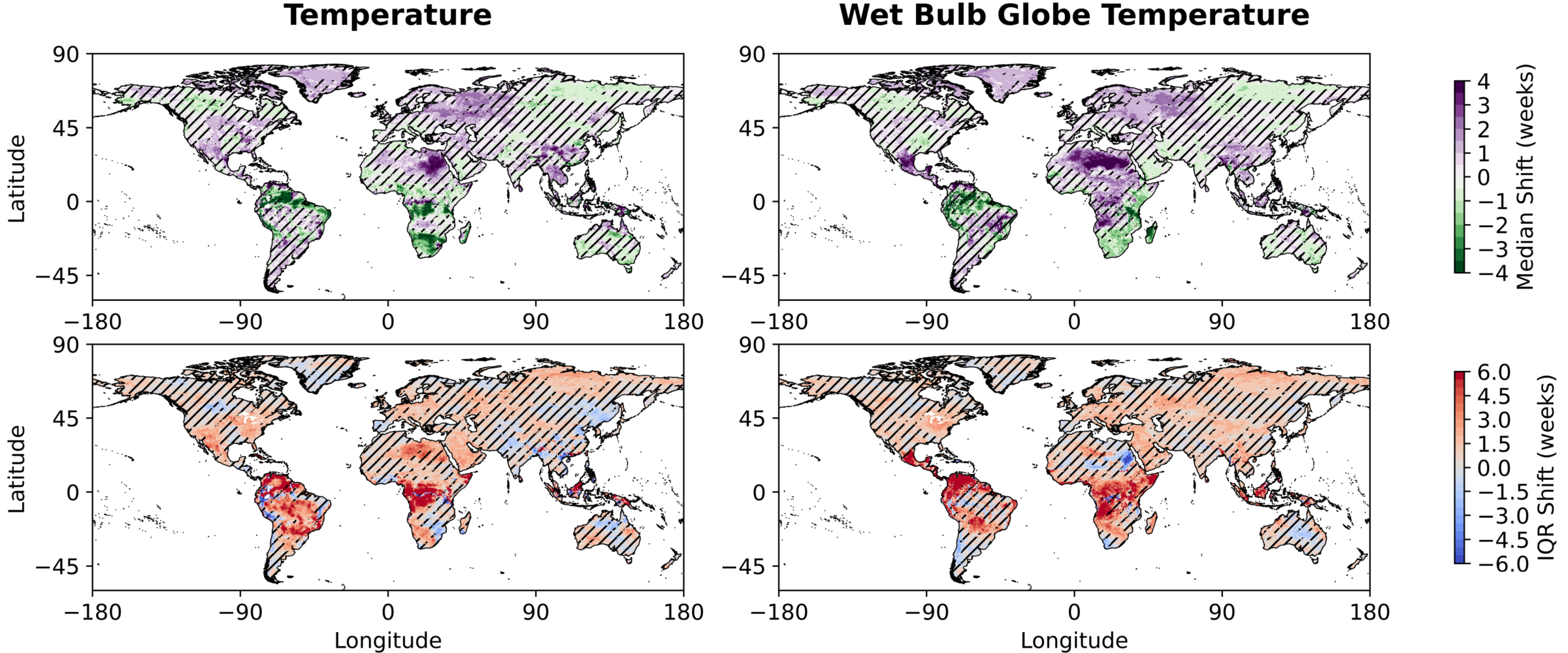
Maps display changes for both dry heat (left) and humid heat (right). The top row highlights regions where peak heat now arrives earlier (green) or later (purple) in the traditional heat season. The bottom row shows where the overall window for extreme heat is lengthening (red) versus regions where it is narrowing (blue). The interquartile range (IQR) measures the middle 50% of a dataset, which researchers use here to define the main duration of the heat season while filtering out isolated, random heat spikes.
<関連情報>
- https://news.climate.columbia.edu/2026/09/10/dangerous-hot-days-are-spreading-beyond-summer/
- https://agupubs.onlinelibrary.wiley.com/doi/10.1029/2026AV002516
極端な乾燥と高温多湿の季節が非対称的に変化している Extreme Dry and Humid Heat Seasons Are Changing Asymmetrically
Catherine C. Ivanovich, Benjamin Cook, Sonali McDermid
AGU Advances Published: 10 September 2026
DOI:https://doi.org/10.1029/2026AV002516
Abstract
Climate change is increasing the frequency of extreme heat events, including outside of the expected heat season. Unusually early or late extremes can create outsized impacts as individuals may be less acclimated to intense heat or unprepared to employ cooling strategies. Here we characterize the global seasonality of extreme dry and humid heat and quantify how seasonality is changing over time. We define local baseline heat seasons as the 3 months with the highest fraction of extreme heat events during 1980–1989. This extreme heat season is distinct from meteorological summer for many regions and captures most observed extreme heat days, even in the tropics where the amplitude of temperature seasonality is low. Over the last 45 years, extreme dry and humid heat seasons have significantly expanded over 50% and 48% of the global land area, respectfully, and this expansion is primarily asymmetric. Regions including the western United States, eastern China, northern Africa, and eastern Europe experienced a greater increase in the fraction of extreme dry and humid heat events following the historical extreme heat season, while regions that experienced a larger increase in the fraction of extremes preceding the extreme heat season include western Europe, southern Africa, and northwestern India. These observed asymmetrical changes in extreme heat occurrence in the shoulder seasons are generally not explainable by an intensification of preexisting seasonality driven by annual mean warming. These results highlight the need for extended heat alert systems and prompt further study of compound events where extreme heat seasons are increasingly overlapping with wildfire and hurricane seasons.