2026-09-08 カリフォルニア大学リバーサイド校(UCR)
<関連情報>
- https://news.ucr.edu/articles/2026/09/08/study-unveils-chemistry-destroying-forever-chemicals
- https://www.nature.com/articles/s44221-026-00696-9
紫外線照射下におけるパーフルオロアルキル物質およびポリフルオロアルキル物質の分解に関する包括的なメカニズムと経路 Comprehensive mechanisms and pathways for per- and polyfluoroalkyl substances degradation under ultraviolet irradiation
Jinyu Gao,Dandan Rao & Jinyong Liu
Nature Water Published:02 September 2026
DOI:https://doi.org/10.1038/s44221-026-00696-9
Abstract
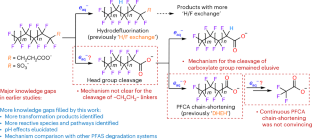
Hydrated electrons (eaq−) produced by ultraviolet (UV) irradiation enable per- and polyfluoroalkyl substance (PFAS) defluorination in water, but surprisingly, most C–F bonds are not reduced to C–H. To elucidate mechanisms and pathways towards deeper defluorination, we analysed products across three legacy PFAS structural families under UV/sulfite conditions. The specific fluorocarbon undergoes sequential reactions with an eaq−, a hydroxyl radical (HO•) and hydroxide ions (HO−), resulting in C–C cleavage. The carboxylate group in the fragmented products is critical for further defluorination. Beyond preserving eaq−, high pH enhances PFAS degradation by promoting the fragmentation and C=C formation. The findings substantially expand the mechanistic scheme, explain the puzzling products previously observed and correct the common misinterpretation of chain-shortening from RF–CF2–COO− to RF–COO−. The primary product is formate rather than CO2 or CO. This study advances fundamental insights for (1) tackling PFAS pollution and (2) designing readily degradable fluorochemicals.