2026-09-03 東京海洋大学,株式会社オンチップ・バイオテクノロジーズ,科学技術振興機構
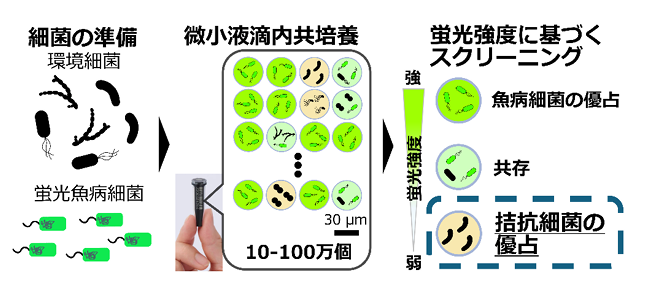
図1 微小液滴を使った有用細菌探索の仕組み
<関連情報>
- https://www.kaiyodai.ac.jp/upload-file/b0e9c23a5fe7f79745470f03ac3ff6363f96ba5e.pdf
- https://www.jst.go.jp/pr/announce/20260903/index.html
- https://www.jst.go.jp/pr/announce/20260903/pdf/20260903.pdf
微小液滴技術を活用したクルマエビ類病原性Vibrio harveyiに対する拮抗細菌の高効率スクリーニング Microdroplet-based high-throughput screening for antagonistic bacteria targeting penaeid shrimp pathogenic Vibrio harveyi
Hajime Yuasa,Yuri Katayama,Kayo Konishi,Miho Furukawa,Reiko Nozaki,Hidehiro Kondo,Ikuo Hirono & Keiichiro Koiwai
Scientific Reports Published:02 September 2026
DOI:https://doi.org/10.1038/s41598-026-68242-x
Abstract
Antagonistic bacteria that suppress the growth of specific bacteria have attracted attention as an antibiotics-independent strategy for infectious disease control in aquaculture. Microfluidics-based water-in-oil droplets (microdroplets) enable high-throughput screening of antagonistic bacteria in the field of medicine or agriculture. However, the use of this screening system in aquaculture has not yet been reported. In particular, penaeid shrimp aquaculture, one of the largest sectors of global aquaculture, has a strong demand for alternative disease control strategies because vaccination is ineffective. Here, we demonstrated a proof-of-concept study of microdroplet-based high-throughput screening system for antagonistic bacteria targeting penaeid shrimp pathogenic Vibrio harveyi. Using this screening system, we successfully isolated 18 bacterial candidates with potential growth-inhibitory activity, representing three genera (Pseudoalteromonas, Shewanella, and Tenacibaculum), from the bacterial community of kuruma shrimp Penaeus japonicus rearing water. 16S rRNA gene-based bacterial community analysis revealed that these isolates included several low-abundance, rare taxa. Although these isolates showed no inhibitory activity on agar plates, one out of four tested strains showed a trend toward improved survival during co-infection tests using kuruma shrimp. Overall, our study highlights both the potential and limitation of microdroplet-based antagonistic bacterial screening to accelerate the development of biological control strategies in shrimp aquaculture.