2026-08-31 ワシントン大学(UW)
<関連情報>
- https://www.washington.edu/news/2026/08/31/august-research-highlights-nectar-robbing-anxious-attachment-styles-persnickety-plasma-more/
- https://pubs.acs.org/jacsat/article-abstract/148/33/35898/5255804/Synthesis-and-Magnetism-of-Silver-Chromium
銀クロムセレン化物スピネルの合成と磁性 Synthesis and Magnetism of Silver Chromium Selenide Spinels
Ezra K. Bacon-Gershman;Samantha M. Harvey;Charlize Agag;Abdul Moeez;Guodong Ren;Sonder Wilson;Yinuo Xu;Daniel R. Gamelin;Lilo Pozzo;Juan Carlos Idrobo;Brandi M. Cossairt
Journal of the American Chemical Society
DOI:https://doi.org/10.1021/jacs.6c09346
Abstract
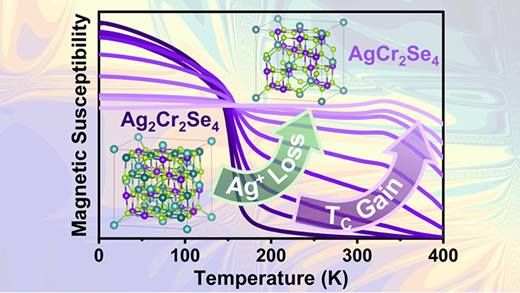
Chalcogenide spinels exhibit electronic and magnetic properties that are tunable through lattice occupancy and composition. Here, we report the first synthesis of spinel-phase Ag2Cr2Se4 and AgCr2Se4 and demonstrate an oxidation-induced ferro-to-ferrimagnetic transition accompanied by a massive increase in TC of >250 K associated with changes in Ag+ site occupancy. The Ag spinels are synthesized through air-free cation exchange of CuCr2Se4 nanocrystals driven by excess AgNO3 to yield ferromagnetic Ag2Cr2Se4 (a = 10.838(4) Å, TC = 152 K, 2 K saturation = 3.1 μB/Cr) with Ag+ occupying both Td 8a and Oh 16c sites. Upon air exposure, Ag2Cr2Se4 converts to ferrimagnetic AgCr2Se4 (a = 10.6085(19) Å, TC > 400 K, 2 K saturation = 2.2 μB/Cr) through a loss of Oh-Ag+ alongside the formation of Ag2Se. We attribute the ferro-to-ferrimagnetic transition to the generation of holes in Ag–Se bands, which couple antiferromagnetically to Cr3+. This Ag–Cr–Se spinel system demonstrates the largest change in TC reported and provides an excellent framework for further exploration of magnetic coupling as a function of oxidation and structure.