2026-08-31 ワシントン大学(UW)
<関連情報>
- https://www.washington.edu/news/2026/08/31/august-research-highlights-nectar-robbing-anxious-attachment-styles-persnickety-plasma-more/
- https://pubs.aip.org/aip/pop/article/33/7/072108/3399164/Control-of-kinetic-plasma-instabilities-by-laser
レーザー場による運動学的プラズマ不安定性の制御
Control of kinetic plasma instabilities by laser fields
Nicolas Crouseilles;Lukas Einkemmer;Qin Li;Uri Shumlak;Yukun Yue
Physics of Plasmas Published:July 23 2026
DOI:https://doi.org/10.1063/5.0315595
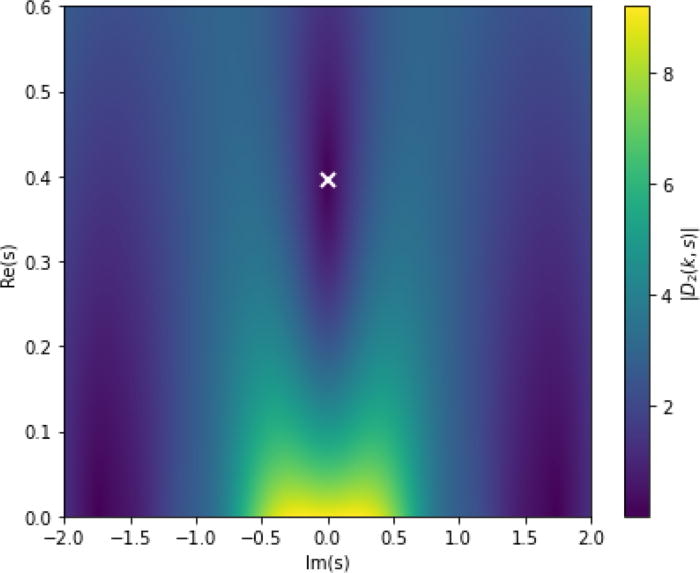
We study the possibility of controlling kinetic plasma instabilities by using lasers to apply external transverse electromagnetic fields. We derive the dispersion relation for the corresponding mathematical description, a reduced Vlasov–Maxwell system, by extending the well-known Penrose condition. It is observed that, under very mild assumptions, the dispersion relation decouples into two parts. The first part is identical to the classic Penrose condition for the Vlasov–Poisson system, while the second part describes the influence of the laser on the transverse dynamics (e.g., a Weibel instability). In particular, this means that the longitudinal dynamics (e.g., a two-stream instability) cannot be stabilized in this manner as far as linear theory is concerned. We show that, however, nonlinear effects can be used to couple the two parts and achieve an effective control. This is done by determining the control parameters (i.e., the form of the external electric and magnetic fields) by solving a partial differential equation (PDE)-constrained optimization problem.