2026-08-18 国立天文台
© 2026- Iwata et al.
<関連情報>
- https://www.miz.nao.ac.jp/veraserver/news/reports/20260818_SN2024iss/
- https://academic.oup.com/pasj/advance-article/doi/10.1093/pasj/psag093/8753065
IIb型超新星SN 2024issの周星環境に関する電波による制約 Radio constraints on the circumstellar environment of the type IIb supernova SN 2024iss
Yuhei Iwata,Tomoki Matsuoka,Masanori Akimoto,Keiichi Maeda,Nozomu Tominaga,Yoshinori Yonekura,Takashi J Moriya,Kotaro Niinuma,Kenta Fujisawa
Publications of the Astronomical Society of Japan Published:06 August 2026
DOI:https://doi.org/10.1093/pasj/psag093
Abstract
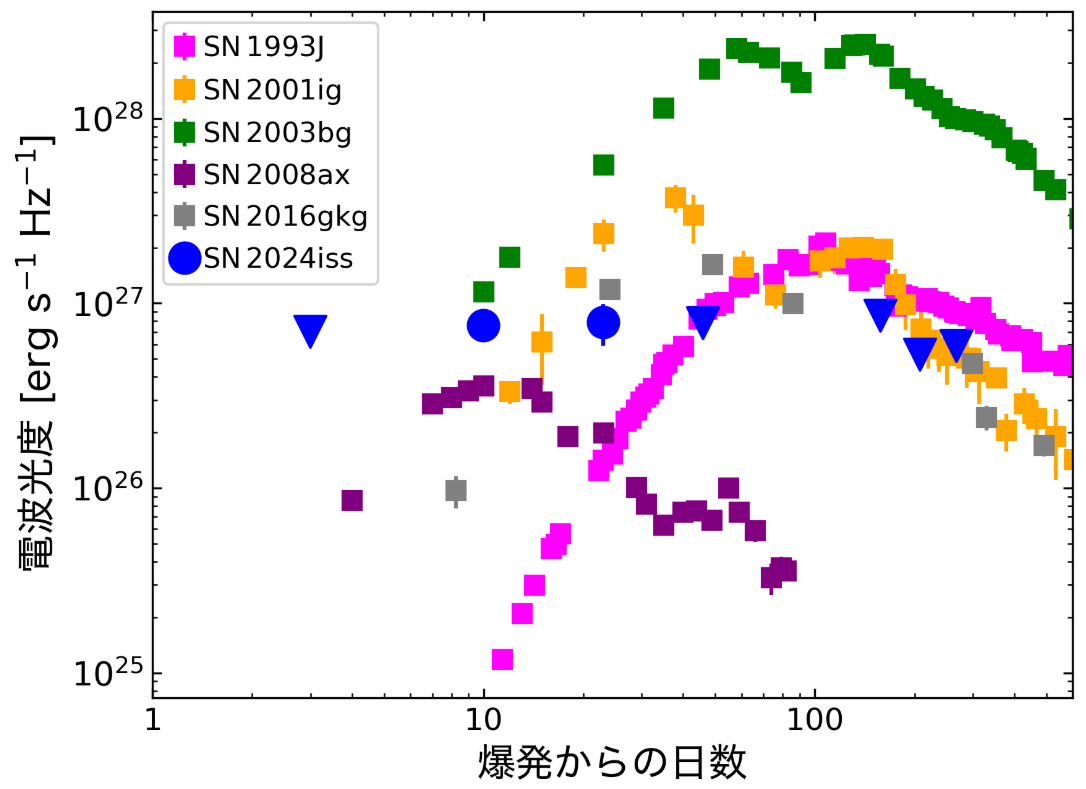
Type IIb supernovae exhibit diverse progenitor properties, and radio observations offer a unique probe of their mass-loss histories shortly before the explosion. We present Japanese VLBI Network single-baseline monitoring of the nearby Type IIb SN 2024iss at 6.9 and 8.4 GHz, spanning approximately one year after its discovery. Our radio observations have detected its emission at 10 and 23 d after the explosion, with subsequent epochs yielding nondetections. Based on the peak radio luminosity and peak time, SN 2024iss exhibits radio properties highly comparable to those of compact-envelope events. Using a synchrotron self-absorption (SSA) modeling, we estimate a progenitor mass-loss rate of M・≈2.5×10⁻⁶M⊙yr-1 for a compact progenitor wind velocity of 100km s-1. Furthermore, our SSA analysis yields a mean expansion velocity of Vsh≈3.3×10⁴km s-1, which exceeds the theoretical shock velocity derived from the self-similar solution by a factor of∼2.4 . Even for the conservative upper-bound peak time, the SSA-derived velocity remains larger than the theoretical expectation by a factor of≳1.7 . To explain this velocity excess, we propose the presence of a confined, dense circumstellar matter (CSM) surrounding the progenitor. The shock emergence from this confined CSM may have accelerated the forward shock, pointing to a highly complex and nonsteady mass-loss history shortly before the explosion.