2026-08-19 日本原子力研究開発機構,京都大学,日本大学
<関連情報>
- https://www.jaea.go.jp/02/press2026/p26081901/
- https://www.sciencedirect.com/science/article/pii/S0012821X26003997
火山弧に沿った極端な隆起により、日本アルプスで世界最年少の深成岩体が露出した Extreme exhumation along a volcanic arc exposed the world’s youngest pluton in the Japanese Alps
S. Sueoka, T. Kawakami, K. Suzuki, S. Kagami, T. Yokoyama, B. Shibazaki, M. Nagata, A. Yamazaki, F. Higashino, G.E. King, S. Tsukamoto, F. Herman, T. Tagami
Earth and Planetary Science Letters Available online:3 August 2026
DOI:https://doi.org/10.1016/j.epsl.2026.120218
Highlights
- Exhumation history of the Japanese Alps, including the world’s youngest exposed pluton.
- Exhumation rates ranging 7.5–10.2 mm/yr, among the fastest in the world.
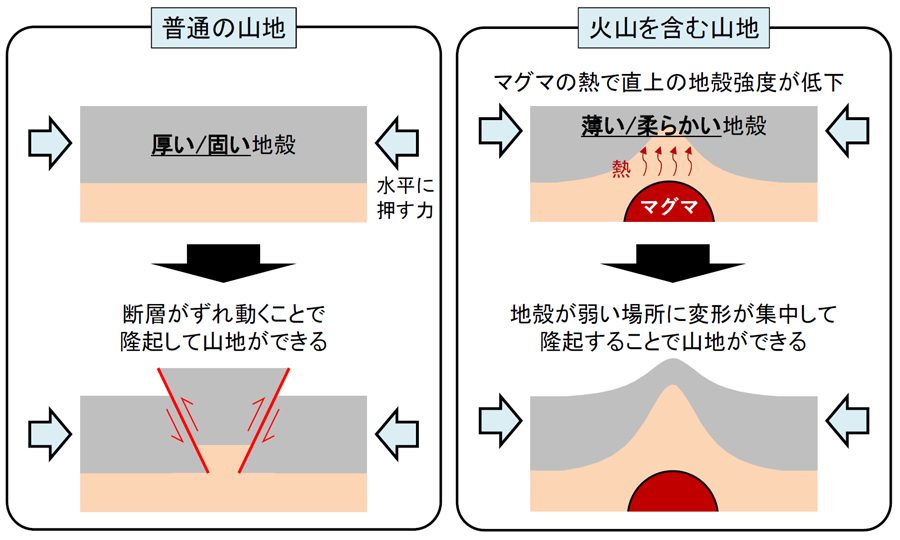
- Deformation localized along hot crust of a volcanic arc caused the rapid exhumation.
- Unique uplift mechanism to volcanic arcs, suggesting subduction-zone-type orogenesis.
Abstract
Geothermobarometry and zircon U–Pb geochronology reveal an episode of extreme exhumation in the Kurobe area of central Japan, characterized by the exposure of the world’s youngest known granite, the middle Pleistocene Kurobegawa Granite. Our results indicate rapid exhumation rates of ∼7.5–10.2 mm/yr since ∼0.8 Ma. These exceptionally high rates, among the highest reported globally over orogenic timescales, demonstrate that extremely rapid crustal unroofing, long studied in continental collision zones, is not restricted to those settings and can also occur in subduction-zone volcanic arcs. Three-dimensional tectonic modeling suggests that this localized exhumation reflects focused deformation within high geothermal-gradient zones along the volcanic arc, combined with late Quaternary horizontal shortening. We infer that thermal structure associated with arc magmatism plays a critical role in enhancing exhumation efficiency. These observations highlight that, in subduction-zone orogens, processes linked to magmatism and slab-derived fluids—important components of subduction-zone tectonics—may significantly contribute to long-term mountain building, complementing more traditional mechanisms of mechanical deformation such as faulting and folding, which have been primarily established in studies of continental collision zones.