2026-08-06 スタンフォード大学
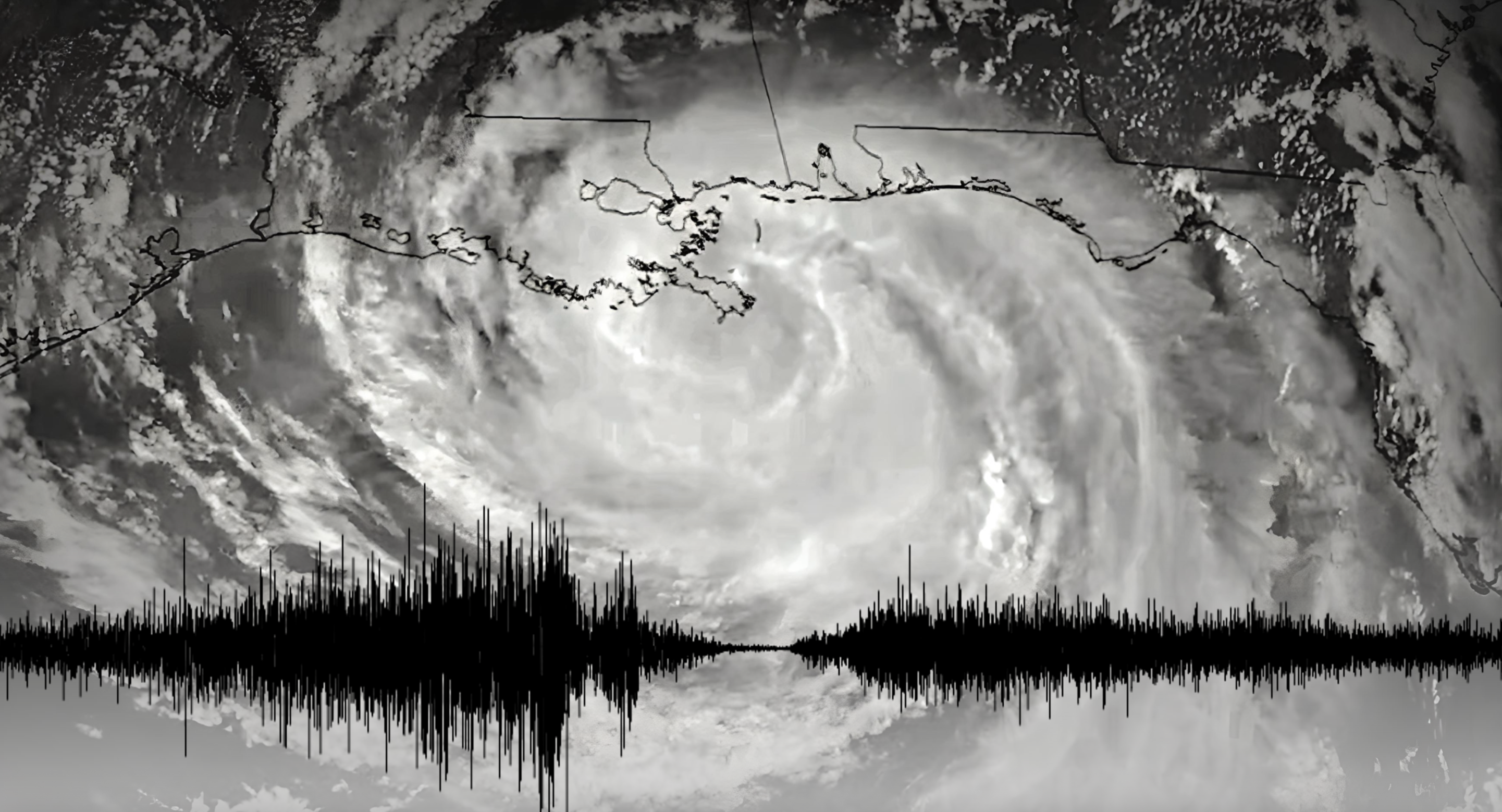
A satellite image of Hurricane Isaac in 2012 as it made landfall on the Louisiana coast. Overlaid on the image is a seismogram showing ground vibrations caused by strong winds before and after the calm eye of the storm passed. | Satellite image by NOAA National Centers for Environmental Information. Seismogram image by the National Science Foundation’s Seismological Facility for the Advancement of Geoscience. Image provided by Qing Ji.
<関連情報>
- https://news.stanford.edu/stories/2026/08/earthquake-sensors-hurricane-data-research
- https://www.science.org/doi/10.1126/science.adt7323
- https://www.sciencedirect.com/science/article/abs/pii/S0012821X24000232
ハリケーン上陸時の乱流地震音響痕跡 Turbulent seismoacoustic imprints during a hurricane landfall
Qing Ji, Ipshita Dey, and Eric M. Dunham
Science Published:6 Aug 2026
DOI:https://doi.org/10.1126/science.adt7323
Abstract
Hurricane evolution is affected by turbulence in the hurricane boundary layer (HBL), which is typically measured using aircraft flights and towers. Through a case study of a landfalling hurricane, we show that seismoacoustic data can also be used for HBL turbulence analysis. We identified contributions of HBL turbulence in infrasound pressure and seismic displacement, validating our interpretation by combining large-eddy simulation, calibrated with meteorological data, with quasi-static elastic deformation modeling. The convection velocity of the turbulent pressure field is key to this pressure–displacement coupling. For atmospheric studies, continuous infrasound pressure serves as a proxy for 10-meter wind speed, and the inertial subrange of pressure spectra provides an estimate of the turbulent dissipation rate near the top of the surface layer at ~100 to 200 meters, complementing portable tower data at ~10 meters.
地震ハミング周期帯における大気からの環境ノイズ:ハリケーン上陸の事例研究 Ambient noise from the atmosphere within the seismic hum period band: A case study of hurricane landfall
Qing Ji, Eric M. Dunham
Earth and Planetary Science Letters Available online 3 February 2024
DOI:https://doi.org/10.1016/j.epsl.2024.118589
Highlights
- Landfall of hurricane Isaac in 2012 was recorded by seismic stations.
- Seismic imprint of the hurricane eye and its surrounding eyewall is observed.
- Pressure fluctuations contribute to seismic spectra within period band 20 – 100 s.
- Local quasi-static response dominates the atmosphere-ground coupling.
- Previous explanation of seismic wave generation from the entire storm is flawed.
Abstract
The seismic hum in the ∼20 – 300 s period band is usually explained by the primary mechanism, where ocean infragravity waves exert pressure changes directly on the seafloor. However, there are some indications that atmospheric processes might also contribute to the seismic hum band. Hurricane landfall provides a unique opportunity to investigate the strong seismic ambient noise generated by turbulent pressure fluctuations from the atmosphere. We revisit Hurricane Isaac in 2012 which passed through the Transportable Array (TA) stations after its landfall on the Louisiana coast. Taking advantage of data recorded by co-located pressure sensors and seismometers, we propose the usage of the continuous wavelet transform to perform high-resolution time-frequency analysis, which reveals a clear signature of the hurricane eye and its surrounding eyewall in both pressure and seismic data. Our spectral analysis also captures diurnal cycles in atmospheric noise. Wavelet coherence analysis between pressure and vertical displacement shows a separation of two noise spectral bands dominated by the ocean and atmosphere, respectively, and we focus on the atmospheric noise with period 20 – 100 s, a subset of the seismic hum band. Observations consistently reveal high coherence between pressure and vertical displacement for the atmospheric noise, which suggests a local (∼100 m – 1 km) scale coupling, in contrast to previous modeling that explored a non-local mechanism involving seismic wave generation from the entire hurricane. To test the local coupling hypothesis, we perform hurricane-scale numerical modeling to quantify the seismic contributions from the surface pressure fluctuations at different parts of the hurricane. We integrate surface wind re-analysis data and empirical relations derived from turbulence studies into the description of our input pressure source. Our results demonstrate the local quasi-static nature of the atmospheric noise from the hurricane, different from the previous model which consists of propagating seismic waves. Our modeling paves the way for further local-scale modeling of atmospheric noise based on realistic turbulent pressure fields. The combination of data and knowledge from both seismology and atmospheric sciences is essential to advancing the understanding and applications of atmosphere-generated seismic ambient noise.