2026-07-29 中国科学院(CAS)
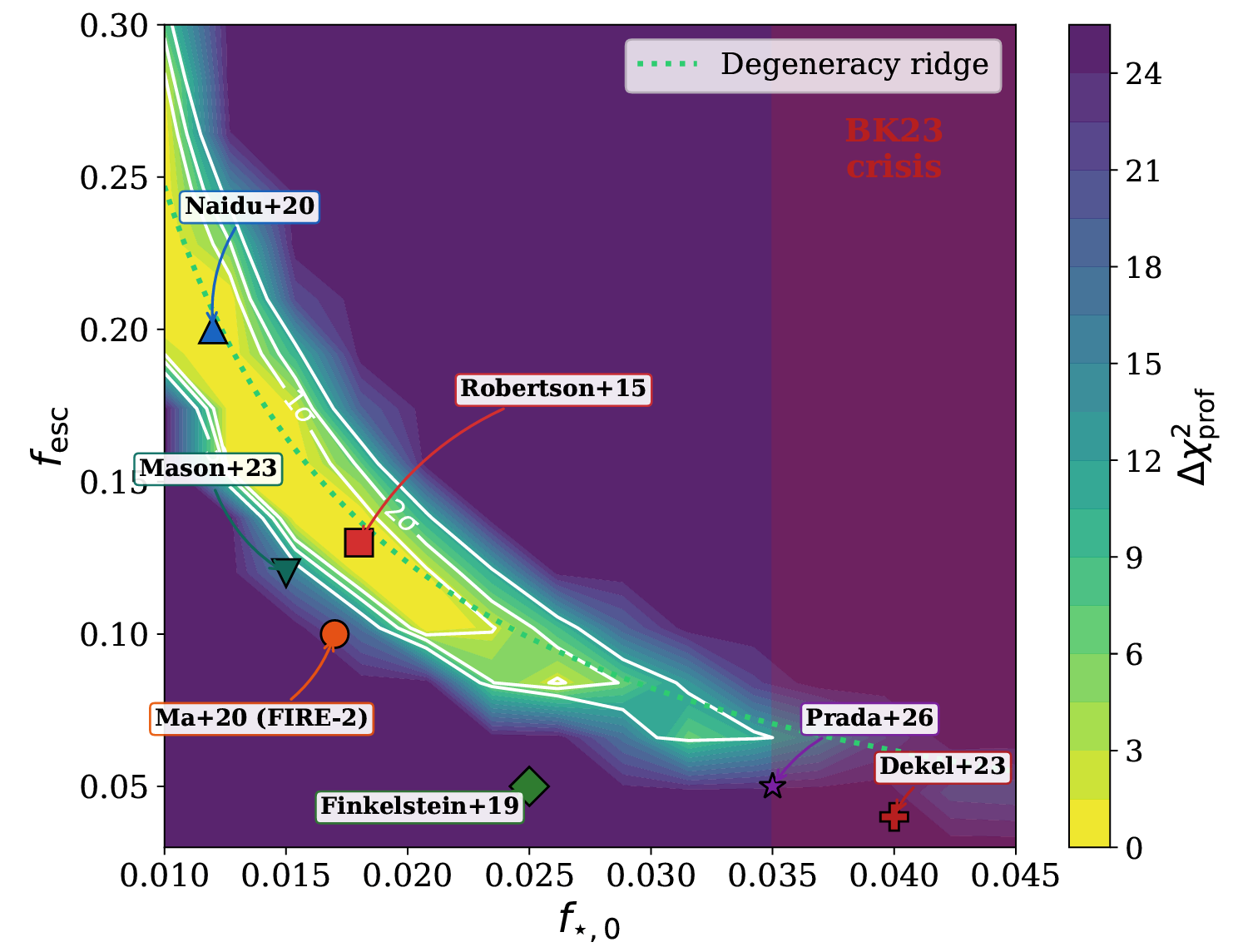
JWST ultraviolet luminosity functions break the reionization-parameter degeneracy. The red shaded region marks the high star-formation-efficiency regime previously associated with the early galaxy “crisis”, while the joint observational constraints significantly exclude this region, indicating that JWST’s bright early galaxies do not necessarily require anomalously high star-formation efficiencies. (Image by SHAO)
<関連情報>
- https://english.cas.cn/newsroom/research-news/202607/t20260731_1186799.shtml
- https://iopscience.iop.org/article/10.3847/2041-8213/ae88f1
JWSTの初期銀河危機は再電離縮退によって解決された The JWST Early Galaxy Crisis Resolved by a Reionization Degeneracy
Zihan Wang and Huanyuan Shan
The Astrophysical journal Letters Published: 2026 July 24
DOI:10.3847/2041-8213/ae88f1
Abstract
JWST’s discovery of unexpectedly bright z > 10 galaxies has triggered claims that standard ΛCDM (cold dark matter) cannot reproduce their abundances, while estimates of the ionizing escape fraction fesc at z > 6 have spanned a factor of four for over a decade. Here we show that both tensions arise from a structural degeneracy in reionization equations: global observables constrain only the product fesc × f⋆,0 (peak star formation efficiency), not individual parameters. We demonstrate that this degeneracy, previously considered a limitation, provides a precise diagnostic framework. By leveraging JWST UV luminosity function shapes to independently constrain f⋆,0, we derive robust bounds on fesc. Joint profile-likelihood analysis across Gaussian, log-normal, and duty-cycle burst scatter models excludes the proposed crisis threshold (ε > 3.5%) at 4.5σ confidence, with stochastic star formation histories strengthening rather than weakening the result. Combining these constraints with constant and evolving f⋆,0 measurements yields a nonparametric reconstruction of fesc(z) across z = 7–12, anchored point-by-point to independent JWST f⋆,0(z) measurements rather than to an assumed functional form. A constant-efficiency scenario (fesc ≈ 10–16%) connects smoothly to low-redshift direct detections, whereas an evolving scenario (fesc ≈ 6% at z = 12) conflicts with low-metallicity Inter Stellar Medium (ISM) porosity expectations. JWST Cycles 3–4 will distinguish these pathways at >2σ, transforming a long-standing fundamental inference barrier into a powerful quantitative probe of early-universe physics.