

2026-07-31 京都大学
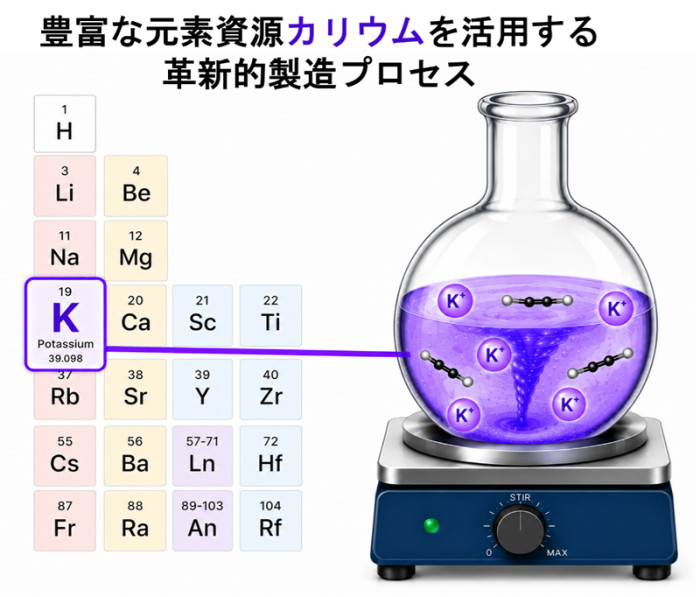
研究概要図(作成:黒木尭、ChatGPT-5.5による描画支援を利用)
<関連情報>
- https://www.kyoto-u.ac.jp/ja/research-news/2026-07-31
- https://www.cell.com/chem/fulltext/S2451-9294(26)00252-4
有機カリウムによる選択的有機合成:カリウムを⽤いるアルキンのanti-ボリル官能基化 Organopotassium for selective synthesis: Potassium-mediated anti-borylfunctionalization of alkynes
Ziwei Zhang ∙ Takashi Kurogi ∙ Hideki Yorimitsu
Chem Published:July 29, 2026
DOI:https://doi.org/10.1016/j.chempr.2026.103186
Highlights
- Abundant potassium enables anti-selective reductive difunctionalization of alkynes
- Flow microreactors enable regioselective unsymmetrical anti-borylfunctionalization
- The anti-selectivity contrasts with lithium- and sodium-based syn-selectivity
- The method enables controlled synthesis of useful alkenylboron compounds
Summary
Organopotassium compounds, though known for over a century, have rarely been utilized for organic synthesis because of their unmanageably high reactivity. We report a reductive strategy for the generation of organopotassiums from alkynes to achieve uniquely anti-selective borylfunctionalization. The anti-diboration reaction with a bulky trialkoxyborane proceeds with broad substrate scope in a conventional flask to yield the synthetically useful building blocks (E)-diborylalkenes. Flow microreactors offer precise control, enabling unsymmetrical installation of a boryl and another functional group in an anti-fashion to furnish high-value, multi-substituted alkenes with excellent regio- and stereoselectivity. Combined experimental and computational studies reveal that the potassium-induced anti-selectivity, which is opposite to the sodium-induced syn-selectivity, arises from the larger ionic radius of potassium. These findings establish a principle for stereochemical control using abundant alkali metal elements and provide efficient sustainable approaches to the synthesis of pharmaceuticals, agrochemicals, and functional materials.

