2026-07-28 農研機構,広島大学,群馬県畜産試験場,東北大学
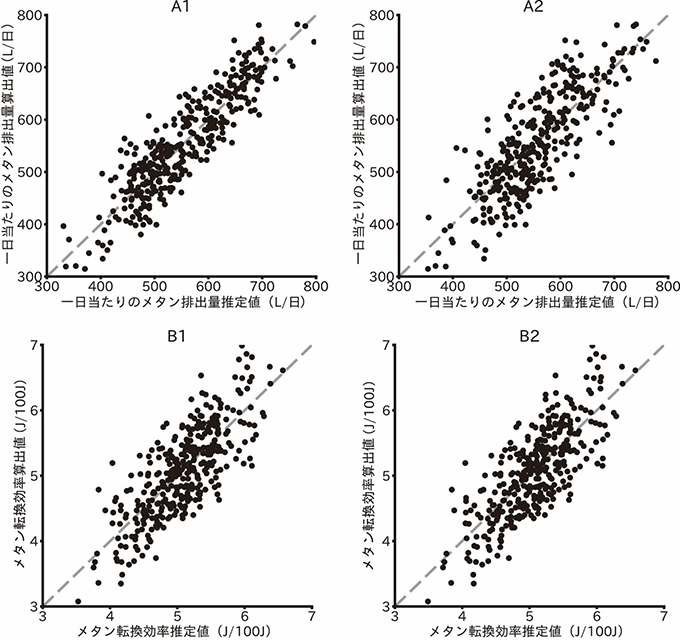
図1 算出値と各開発式における推定値のプロット図
灰色の点線は算出値と推定値が一致する部分である。
<関連情報>
- https://www.naro.go.jp/publicity_report/press/laboratory/nilgs/176906.html
- https://onlinelibrary.wiley.com/doi/10.1111/asj.70219
ホルスタイン牛における体重および乳成分特性(新規脂肪酸、混合脂肪酸、および既成脂肪酸の比率を含む)から腸内メタン関連特性を予測する Prediction of Enteric Methane-Related Traits From Body Weight and Milk Composition Traits, Including Ratios of De Novo, Mixed, and Preformed Fatty Acids in Holstein Cows
Ryoki Tatebayashi, Akiko Nishiura, Fuminori Terada, Tomohisa Tomaru, Taketo Obitsu, Yoshinobu Uemoto, Tomoyuki Suzuki, Itoko Nonaka, Yuriko Saito, Osamu Sasaki
Animal Science Journal Published: 10 July 2026
DOI:https://doi.org/10.1111/asj.70219
ABSTRACT
The aim of this study was to develop prediction equations for methane-related traits in Holstein cows using body weight (BW) and milk composition traits, including the proportions of de novo (DEN), mixed (MIX), and preformed (PRF) fatty acids in milk fat. A total of 358 measurements from 92 Holstein cows were used in regression analyses for methane emission (CH4, L/day), methane conversion factor (MCF), and the CH4:CO2 ratio. Independent variables included BW, energy-corrected milk (ECM), milk yield, milk protein percentage (PRO), milk fat percentage, lactose percentage, protein-to-fat ratio (PFR), DEN, MIX, and PRF. Four well-fitted equations were developed for CH4 and MCF. The best fitted equation was as follows: CH4 = −78.58 + 0.5632 × BW + 8.273 × ECM + 17.75 × PRO − 181.7 × PFR + 6.151 × DEN − 2.225 × MIX. When BW was excluded from the CH4 equation, prediction bias was observed across parities and lactation stages. This bias was reduced by developing parity-specific equations. These equations show moderate accuracy in validation. These findings demonstrate that methane-related traits can be effectively predicted using routinely collected animal and milk composition data, offering the potential for improved methane monitoring and mitigation strategies in dairy production.