2026-07-29 北海道大学,東京農業大学,かずさDNA研究所,九州大学
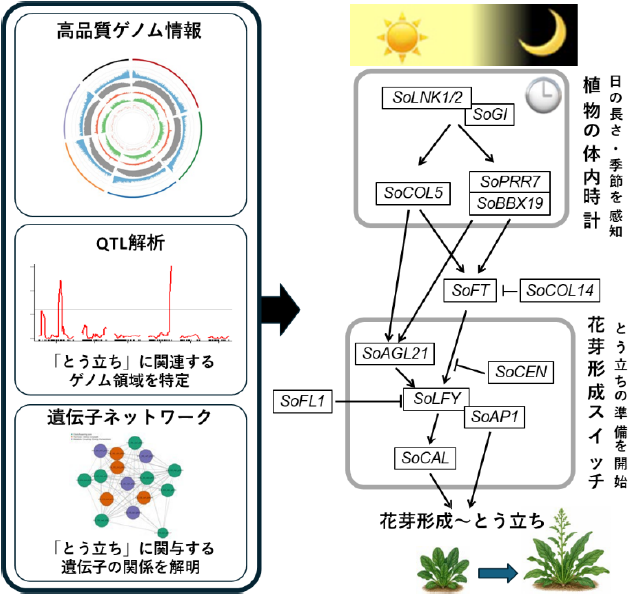
ほうれん草が「とう立ち」する仕組みをゲノム解析で解明。
<関連情報>
- https://www.hokudai.ac.jp/news/2026/07/post-2387.html
- https://academic.oup.com/jxb/advance-article-abstract/doi/10.1093/jxb/erag330/8744052
高品質ほうれん草参照ゲノムと共発現解析により、概日時計と花成開始に関わる遺伝子ネットワークを解明 A high-quality spinach reference genome and co-expression analysis reveal circadian and floral initiation gene networks
Kaoru Yamano,Sota Yunoki,Kazuki Higuchi,Babil Pachakkil,Keisuke Tanaka,Sachiko Isobe,Kenta Shirasawa,Hideki Hirakawa,Yasuyuki Onodera
Journal of Experimental Botany Published:28 July 2026
DOI:https://doi.org/10.1093/jxb/erag330
Abstract
Bolting time is critical for yield stability in spinach, a long-day Amaranthaceae crop whose photoperiod-dependent flowering pathway remains incompletely understood. We generated a chromosome-scale reference genome for an early-bolting spinach line (944.6 Mb; 97.9% BUSCO completeness) and used it to integrate QTL mapping, sequence variation, and transcriptome-based co-expression analysis. Remapping bolting-time QTLs on this improved reference retained qBt2.1, qBt3.1, and qBt3.2, while refining their physical intervals and candidate gene content. Candidate loci included SoCOL14/SoFL1 at qBt2.1, SoFT3 at qBt3.1, and SoLNK1/SoAGL21 at qBt3.2. Co-expression analysis identified ten modules, including a circadian-associated module M9 containing SoLNK1/2, SoGI, SoCOL5, SoPRR7, and SoBBX19, and a floral-initiation module M10 enriched for shoot-apex regulators. A predicted loss-of-function allele of SoLNK1 in the late-bolting line further supports its prioritization as a candidate regulator. Phylogenetic and network evidence suggest Amaranthaceae-specific remodelling of PRR–BBX-associated photoperiodic regulation in spinach. Together, this genome resource and integrative framework provide a basis for prioritizing bolting-associated genes and dissecting circadian–floral regulatory gene networks in spinach.