2026-07-29 名古屋大学
<関連情報>
- https://www.nagoya-u.ac.jp/researchinfo/result/2026/07/post-1045.html
- https://www.nature.com/articles/s41467-026-75280-6
骨格変換によるキラルナノカーボン分子への変換 Skeletal transformation to chiral nanocarbon molecules
Junichiro Hirano,Tomoyuki Ikai,Shinpei Kusaka,Ryotaro Matsuda,Hiroshi Shinokubo & Norihito Fukui
Nature Communications Published:28 July 2026
DOI:https://doi.org/10.1038/s41467-026-75280-6
Abstract
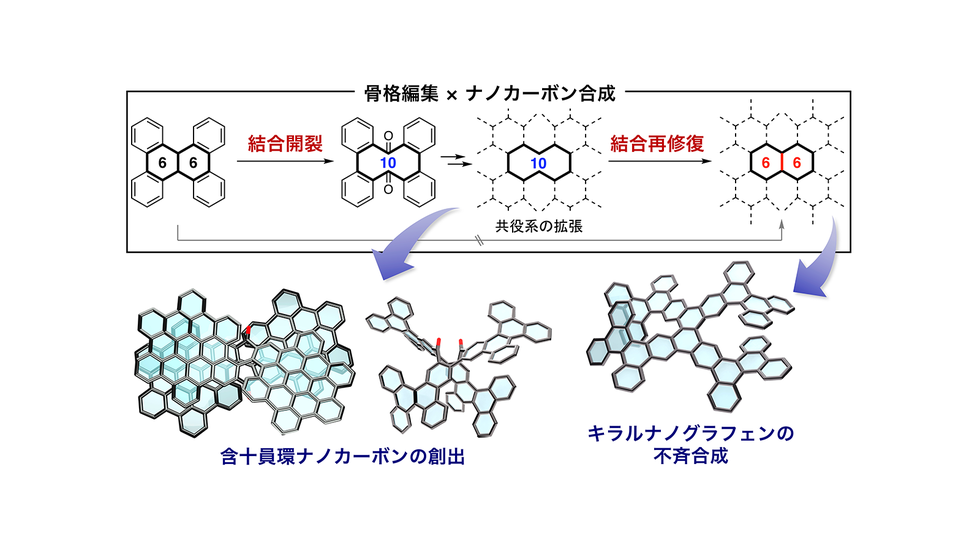
Three-dimensional nanocarbon molecules are crucial building blocks for advanced carbon materials. However, the dependence of current synthetic methods on stepwise bond-forming approaches limits the available chemical space in this field. Here, we demonstrate that a skeletal-transformation approach solves two challenges in nanocarbon synthesis. Firstly, the inner-bond cleavage of π-conjugated hydrocarbons provides access to a ten-membered ring that exclusively contains sp2-hybridized carbons. The subsequent ring-expansion affords three gigantic decagon-containing chiral nanocarbon molecules with figure-eight or bathtub conformations consisting of up to 170 sp2-hybridized carbons. Secondly, the subsequent reformation of an internal double bond in the structure is applicable to two of three obtained nanocarbon molecules, which enables the regio- and enantio-selective synthesis of a helically twisted nanographene containing up to 26 six-membered rings. The crystal-packing structure of this chiral nanographene is characterized by a homochiral porous framework consisting of π-stacked double-helical assemblies. These results demonstrate that the skeletal-transformation approach, which has so far targeted bioactive molecules, can be applied to nanocarbon synthesis.