
2026-07-15 ノースカロライナ州立大学(NC State)
<関連情報>
- https://news.ncsu.edu/2026/07/extending-the-limits-of-twistronics/
- https://pubs.acs.org/doi/full/10.1021/acsnano.6c04794
大面積・高結晶性酸化物モアレ超格子の決定論的作製 Deterministic Fabrication of Large-Area, High-Crystallinity Oxide Moiré Superlattices
Reza Ghanbari,Eli Rodrigues,Young-Hoon Kim,Konnor Koons,Yan Li,Kabelo Lebogang,Yiming Ding,Douglas W. Barefoot,Yueyin Wang,Yin Liu,Hua Zhou,Miaofang Chi,and Ruijuan Xu
ACS Nano Published: July 13, 2026
DOI:https://doi.org/10.1021/acsnano.6c04794
Abstract
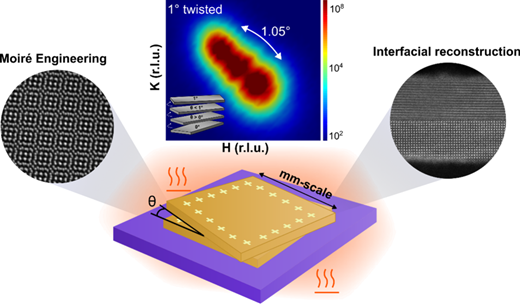
Oxide twistronics extends moiré engineering beyond van der Waals materials, offering a promising platform for accessing emergent interfacial phenomena arising from the strong coupling of lattice, charge, and orbital degrees of freedom in complex oxides. However, deterministic fabrication of high-crystallinity oxide moiré superlattices over large lateral dimensions remains challenging due to the three-dimensional bonding network of oxides. Here, we demonstrate a scalable, generalized fabrication strategy that enables the formation of high-crystallinity oxide moiré superlattices with clean, chemically bonded interfaces and precisely controlled twist angles down to nominal values of 0.1°, achieving subdegree twist-angle accuracy across large contiguous lateral dimensions approaching the millimeter scale. Using NaNbO3 as a model system, we show that the resulting interlayer coupling drives pronounced structural reconstruction that modifies both the phase structure and ferroelectric domain configuration. Synchrotron-based X-ray 3D reciprocal space mapping reveals the emergence of a single-phase state in twisted bilayers, in contrast to the mixed-phase structure observed in single-layer membranes prior to twist assembly. The structural signatures are further consistent with gradual lattice rotation distributed along the thickness direction that may accommodate interfacial shear strain, distinct from reconstruction observed in van der Waals moiré systems which primarily occurs through in-plane stacking rearrangement. This collective lattice response is correlated with twist-dependent nanoscale electromechanical modulations observed by piezoresponse force microscopy. These results establish a scalable materials platform for oxide twistronics and support the implementation of twist-engineered functionalities in practical, macroscale device architectures.

