2026-07-08 マサチューセッツ工科大学(MIT)
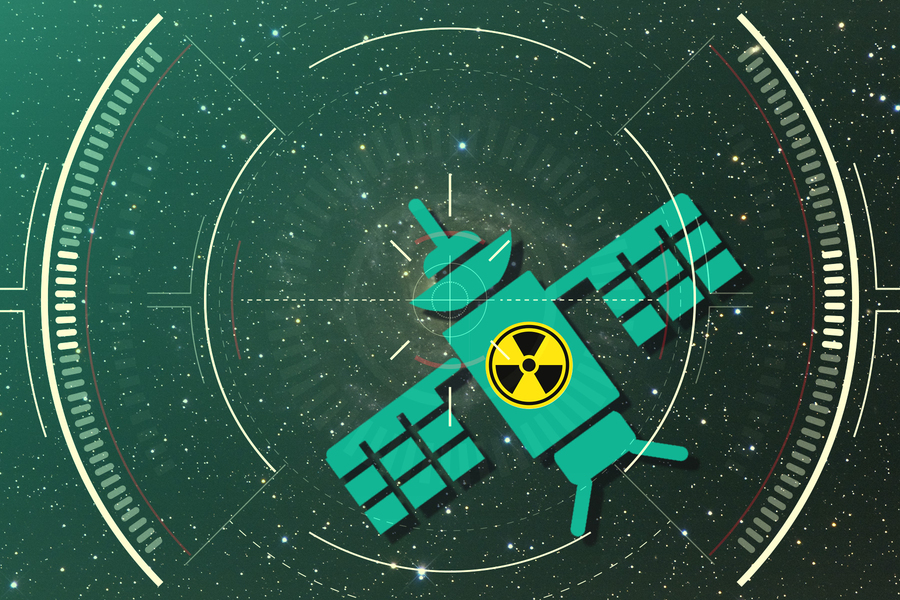
MIT Professor Areg Danagoulian is proposing a way to determine if a satellite contains a nuclear weapon. Credit: MIT News; iStock
<関連情報>
- https://news.mit.edu/2026/mit-researcher-proposes-way-to-detect-nuclear-weapons-in-space-0708
- https://www.nature.com/articles/s41586-026-10783-2
宇宙陽子を用いた宇宙条約の検証 Verification of the Outer Space Treaty with cosmic protons
Areg Danagoulian
Nature Published:08 July 2026
DOI:https://doi.org/10.1038/s41586-026-10783-2
Abstract
The Outer Space Treaty (OST) was opened to signatures in 1967 and, since then, 117 countries, including China, the USA and Russia, have become part of it1. Among other stipulations, the treaty bans the placement of nuclear weapons in outer space. Recently, the US government has raised worries that Russia is testing nuclear-armed anti-satellite weapon (ASAT) components, with the possibility that it will place a nuclear weapon in space. Such a device, if detonated, would destroy most of the satellites in the low Earth orbit. This danger is compounded by the lack of a verification mechanism for the OST. No methodologies of verification have been proposed in the open peer-reviewed literature. Here a concept and feasibility study is presented for verifying a satellite’s compliance to the OST by observing the neutrons induced by spallation from the approximately GeV protons in the inner Van Allen radiation belts2. The calculations show that a 9U-CubeSat-sized detection platform can identify a thermonuclear weapon from a distance of 4 km in approximately one week of observation. This conceptual study will stimulate and inform future research and development of verification platforms for the OST.