2026-06-30 合肥物質科学研究院(HFIPS)
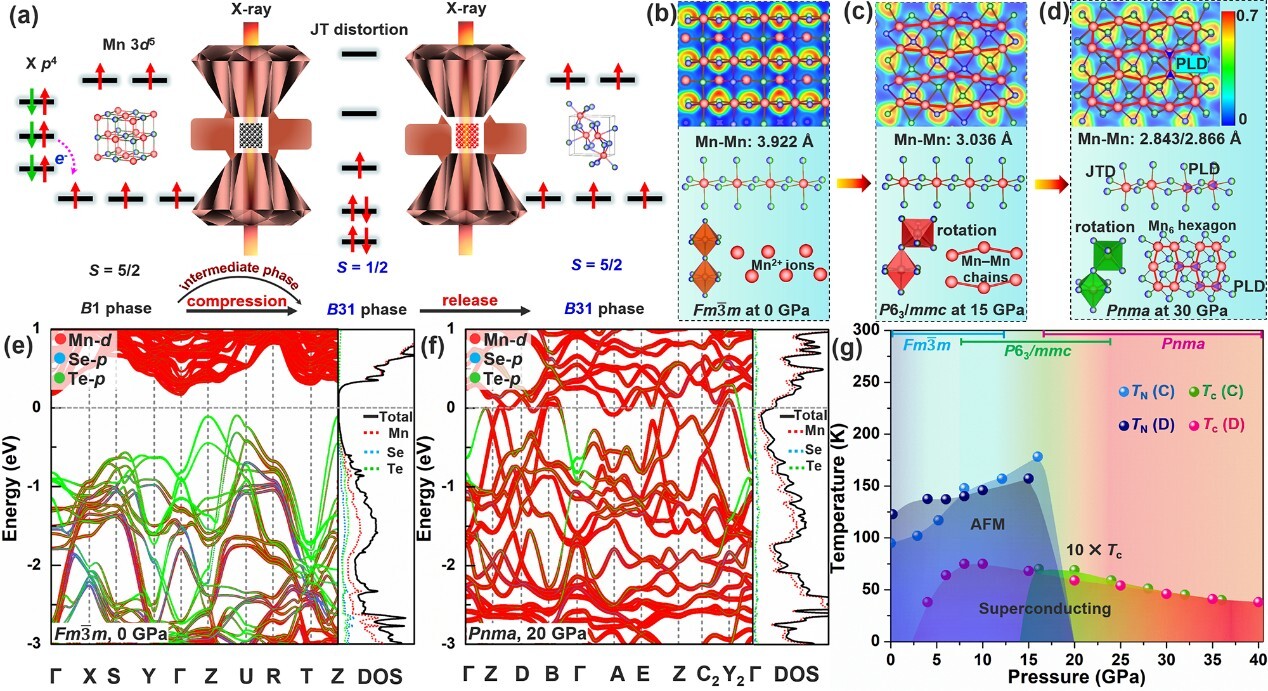
Cooperative structural distortion, band structures, and pressure‑dependent transport and superconductivity in MnSe0.5Te0.5 during compression and decompression. (Image by WANG Pei)
<関連情報>
- https://english.hf.cas.cn/nr/rn/202606/t20260630_1175047.html
- https://advanced.onlinelibrary.wiley.com/doi/10.1002/adma.202521905
圧力誘起ヤーン・テラー歪みによって開始される構造由来超伝導を伴うB31型MnSe0.5Te0.5相の捕捉 Capture of B31-Type MnSe0.5Te0.5 Phase With Structure-Borne Superconductivity Initiated by Pressure-Induced Jahn–Teller Distortions
Pei Wang, Jing Zhao, Di Peng, Dongxuan Han, Yuxin Liu, Fujun Lan, Liping Wang, Qiaoshi Zeng, Yusheng Zhao, Xianlong Wang
Advanced Materials Published: 21 May 2026
DOI:https://doi.org/10.1002/adma.202521905
ABSTRACT
Superconductivity in manganese-based compounds is strongly dependent on their high-pressure phases. Consequently, capturing high-pressure superconducting phases, particularly those that cannot be crystallized in their bulk form at ambient condition yet retain superconductivity, is of significant interest. Here, we report the capture of a superconducting high-pressure B31-type MnSe0.5Te0.5 phase (space group Pnma) at ambient pressure, achieved via chemical substitution-induced irreversible phase transitions (Fm3–m⇀P63/mmc⇀Pnma) and reversible spin-crossover under a hydrostatic compression-decompression cycle up to ≈40 GPa. Upon decompression, the B31 phase exhibits structure-borne superconductivity that persists down to ≈4 GPa, with a maximum Tc of ≈7.5 K at ≈8 GPa. DFT calculations reveal that the accumulated pressure-induced charge transfer (ligand-to-Mn2+) causes an abrupt Jahn–Teller distortion (JTD) in MnX6 octahedra by lifting the t2g orbital degeneracy in low-spin Mn2+ (d5). The JTD triggers Peierls-like metallic Mn–Mn dimerization, facilitating electron-pairing by driving local electron redistribution, thereby initiating superconductivity in the orthorhombic phase. These findings demonstrate an approach to retain a superconducting phase through chemical substitution-induced irreversible phase transition under high-pressure.