
2026-06-26 オックスフォード大学
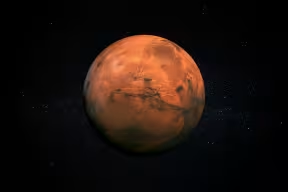
A new study led by the University of Oxford suggests that Mars once hosted enormous, interconnected magmatic systems rather than simple isolated volcanoes. Image credit: 24K-Production, Getty Images (with elements provided by NASA).
<関連情報>
- https://www.ox.ac.uk/news/2026-06-24-new-evidence-suggests-vast-hidden-magma-systems-inside-mars
- https://www.nature.com/articles/s41550-026-02907-5
火星における溶融物質が枯渇した下部地殻と地殻を貫通するマグマ活動を示す地震学的証拠 Seismic evidence for a melt-depleted lower crust and transcrustal magmatism on Mars
T. Mackay-Champion,M. Anderson Loake,R. Palin,J. Wade & J.-M. Kendall
Nature Astronomy Published:26 June 2026
DOI:https://doi.org/10.1038/s41550-026-02907-5
Abstract
The crust of Mars preserves a record of early planetary evolution in the absence of plate tectonics, offering crucial insights into the development of terrestrial planets. Seismic data from NASA’s InSight mission reveal a stratified crust with an intracrustal seismic discontinuity at ~24 km, overlying the crust–mantle boundary at ~38 km. The nature of this intracrustal discontinuity remains unresolved. Here, however, using phase equilibrium modelling integrated with petrophysics and Bayesian statistics, we show that it marks a transition from mafic to ultramafic lithologies and interpret the lowermost ultramafic layer as a ~14-km-thick melt-depleted cumulate zone overlying the petrologic crust–mantle boundary. Thermal modelling indicates that such a melt-depleted layer could not have formed under ambient temperature conditions; instead, it requires an elevated heat flow probably driven by mantle upwelling and magmatic intrusion, promoting magmatic differentiation and partial melting within the crust. Together with prior evidence for evolved melts and upper-crustal differentiation, our results indicate that Mars once hosted vertically integrated transcrustal magmatic systems akin to those common on Earth. This demonstrates that these systems and their attendant geochemical differentiation can form without plate tectonics, offering a universal mechanism for building secondary and tertiary crust on hot rocky planets.

