

2026-05-29 東北大学
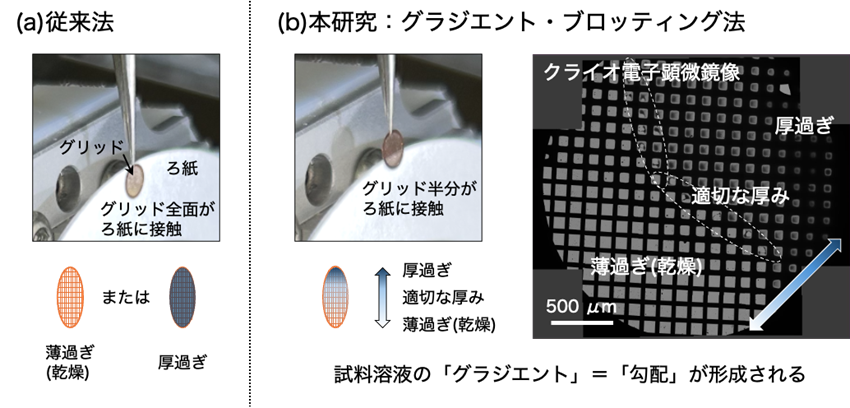
図1. メタノール凍結グリッドの作製。
(a)従来法では、グリッド全面をろ紙に接触させ、余分な溶液を除去する。しかし、メタノールは揮発速度が速いため、グリッド全体が乾燥するか、膜が厚くなり過ぎて、クライオ電子顕微鏡観察に適した凍結薄膜を再現よく得ることは困難であった。
(b)本研究で用いた「グラジエント・ブロッティング法」。グリッドの約半分のみをろ紙に接触させることで、グリッド上で試料溶液の厚さの勾配が形成される。その結果、厚い領域と薄い領域の中間に、クライオ電子顕微鏡観察に適した厚みの凍結薄膜を再現よく形成できる。
<関連情報>
- https://www.tohoku.ac.jp/japanese/2026/05/press20260529-01-Cryo.html
- https://academic.oup.com/jmicro/advance-article-abstract/doi/10.1093/jmicro/dfag027/8697310
有機溶媒系のクライオEELS元素マッピング Cryo-EELS elemental mapping of organic-solvent systems
Daisuke Unabara ,Yohei K Sato ,Tasuku Hamaguchi ,Koji Yonekura
Microscopy Published:29 May 2026
DOI:https://doi.org/10.1093/jmicro/dfag027
Abstract
Cryogenic transmission electron microscopy (cryo-TEM) is a powerful method that enables the observation of nanomaterials while preserving the specimen in a vitrified state, and minimizing damage caused by the electron-beam irradiation. Although cryo-TEM has been widely applied to aqueous specimens, its application to organic solvent systems remains limited. Because the physicochemical properties of organic solvents differ markedly from those of water, efficient vitrification methods have not yet been well established to date. More critically, organic solvents are highly susceptible to electron-beam irradiation. In this study, we selected methanol–the smallest polar alcohol molecule –and optimized the vitrification protocol for the observation of samples containing organic solvents. This resulted in a reproducible blotting method for forming thin solvent films, along with suitable freezing conditions for producing amorphous methanol. We further aimed to expand the application of cryo-TEM to materials in organic solvent systems by performing cryogenic electron energy-loss spectroscopy (cryo-EELS) elemental mapping. The technique, recently developed by our group for frozen aqueous solutions, enabled the detection of elemental signals even from frozen methanol and provided insights into their spatial distributions. Furthermore, silicon signals from mesoporous silica nanoparticles (MSNs) dispersed in methanol were clearly observed. These results demonstrate that both solvent components and nanomaterials can be visualized and analyzed within frozen organic solvents, thereby expanding the potential of cryo-TEM for advanced materials research involving organic solvent systems.

