2026-05-26 シンガポール国立大学(NUS)
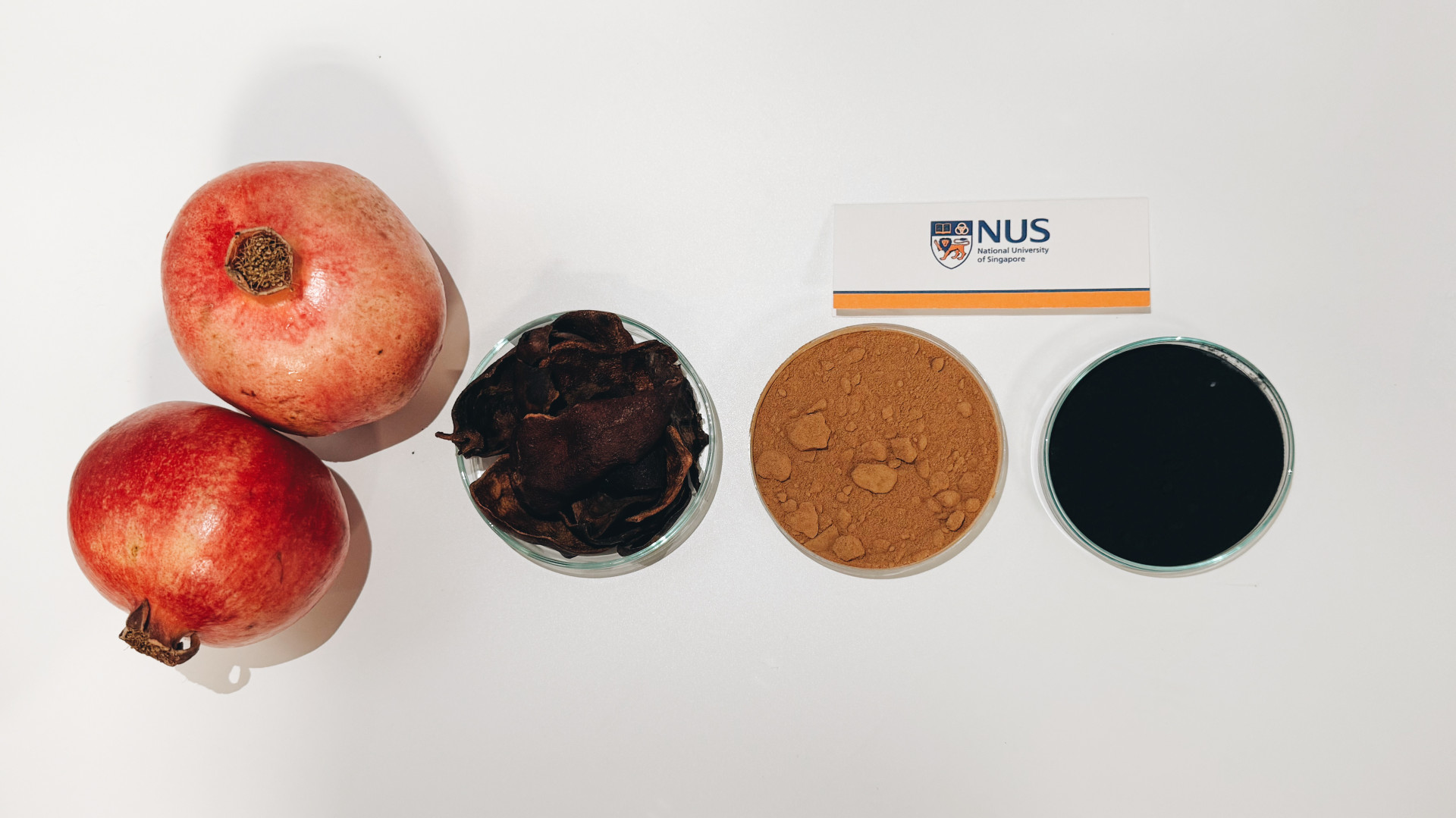
From fresh pomegranates and discarded peels to powdered peels and the final nanobiochar – depicting the different stages of the process to turn fruit waste into a material for water purification research.
<関連情報>
- https://news.nus.edu.sg/pomegranate-peel-water-purifier/
- https://www.sciencedirect.com/science/article/abs/pii/S2215153226000048
ザクロの皮バイオマス由来のナノバイオ炭を用いた4-ニトロフェノール除去の強化:合成、特性評価、および性能評価 Nanobiochar from pomegranate peel biomass for enhanced 4-nitrophenol removal: synthesis, characterization, and performance evaluation
Kustomo, Sam Fong Yau Li
Environmental Nanotechnology, Monitoring & Management Available online: 16 January 2026
DOI:https://doi.org/10.1016/j.enmm.2026.101123
Abstract
Nanobiochar (NBC) derived from pomegranate peel biomass was engineered as a low-cost, mildly synthesized, and sustainable adsorbent for the efficient removal of 4-nitrophenol (4-NP) from water. NBC was prepared via controlled pyrolysis at 600°C for 2 h (10°C min−1 heating rate, 0.67 L min−1 N2 flow), followed by facile ball milling and ultrasonication to create a high surface area, abundant oxygen-containing functional groups, and nanoscale defect sites tailored for enhanced adsorption performance. Comprehensive characterization using FTIR, XRD, SEM-EDS, TEM, Raman spectroscopy, BET surface area analysis, TGA, zeta potential, and CHN elemental analysis was employed to correlate NBC’s structural and surface properties with its adsorption behavior. Under optimized conditions (pH 6, 15 mg NBC dose, 30 mL 4-NP solution at 298 K), NBC exhibited rapid 4-NP uptake with a maximum adsorption capacity of 84.75 mg g−1 and a removal efficiency exceeding 94.12%. The Langmuir isotherm and pseudo-second-order kinetic models best described the data result, indicating predominant monolayer chemisorption and strong interactions between NBC and 4-NP. Regeneration studies showed that NaOH outperformed HNO3, achieving 85.76% and 20.53% 4-NP removal, respectively, after three consecutive cycles. Overall, NBC demonstrates promising as a practical and environmentally benign adsorbent for advanced treatment of 4-NP-contaminated waters and related phenolic pollutants.