
2026-05-14 東京大学
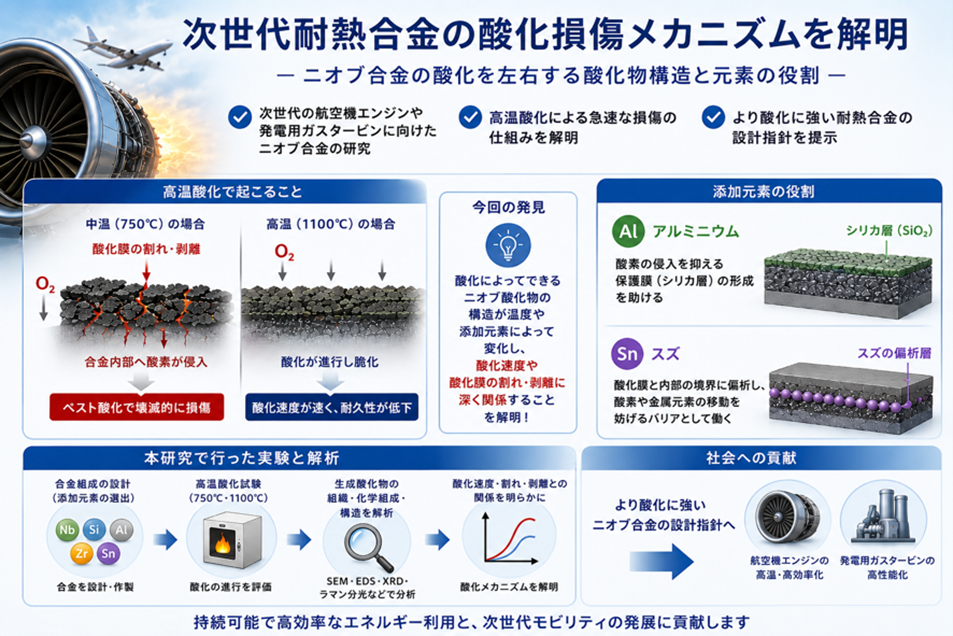
本研究の概要(GPT-5.5、2026年5月13日作成)
<関連情報>
- https://www.k.u-tokyo.ac.jp/information/category/press/0029863.html
- https://www.sciencedirect.com/science/article/pii/S0010938X26003070
Nb基合金の温度依存性酸化劣化メカニズムにおけるNb₂O₅相の進化と溶質相互作用の役割 The roles of Nb2O5 phase evolution and solute interactions in temperature-dependent oxidation degradation mechanisms of Nb-based alloys
Sae Matsunaga, Aya Ajina, Yoko Yamabe-Mitarai
Corrosion Science Available online: 5 May 2026
DOI:https://doi.org/10.1016/j.corsci.2026.113898
Highlights
- Nb₂O₅ polymorph evolution governs oxidation behavior of Nb–Si alloys.
- The difference in alloying additions strongly alters oxide scale morphology and scale adhesion.
- Oxide phase evolution explains temperature-dependent oxidation behavior.
- Solute diffusion and scale adhesion control the oxidation resistance.
Abstract
Catastrophic oxidation remains a major barrier to the application of Nb-based refractory alloys at elevated temperatures. In this study, Oxidation kinetics, oxide scale morphology, phase evolution, and solute interactions at 750 °C and 1100 °C were investigated to elucidate the mechanistic origin of catastrophic oxidation of Nb-based alloys. Precipitation-strengthened Nb-Si alloys, Nb-Si-(Al, Zr)-Sn and Nb-Si-(Al, Zr), were employed as model systems, and oxides were characterized using XRD, SEM/EDS, and Raman spectroscopy. At 750 °C, both Al- and Zr-containing alloys underwent pest oxidation; however, Al-containing alloys showed lower mass gain due to the formation of a continuous amorphous SiO2 layer, whereas Zr-containing alloys underwent rapid fragmentation. At 1100 °C, oxidation proceeded by rapid external scale growth with mixed linear-parabolic behavior. Under these conditions, ternary alloys developed extensive cracks in oxide scales, whereas the Sn-modified alloys exhibited markedly improved scale continuity and adhesion. Detailed analysis revealed that the formation and evolution of Nb2O5 polymorphs were strongly dependent on both alloy composition and temperature, which were closely associated with oxidation kinetics and scale morphology. In the Sn-modified alloys, inward diffusion of Sn and segregation at the interface between oxide scale and an underlying diffuse oxygen-enriched subsurface region indicate the formation of a Sn-rich diffusion barrier, which contributed to reduced oxidation and improved scale adhesion. These results suggest that oxidation resistance in Nb-based alloys is governed by the coupled effects of temperature-dependent Nb2O5 phase evolution, solute interactions, and Sn-assisted diffusion-barrier formation, providing mechanistic guidance for the design of oxidation-resistant refractory alloys.

