2026-05-14 大阪大谷大学,国立環境研究所,長野県諏訪湖環境研究センター,筑波大学,水産研究・教育機構,愛媛大学,松山大学,北海道大学
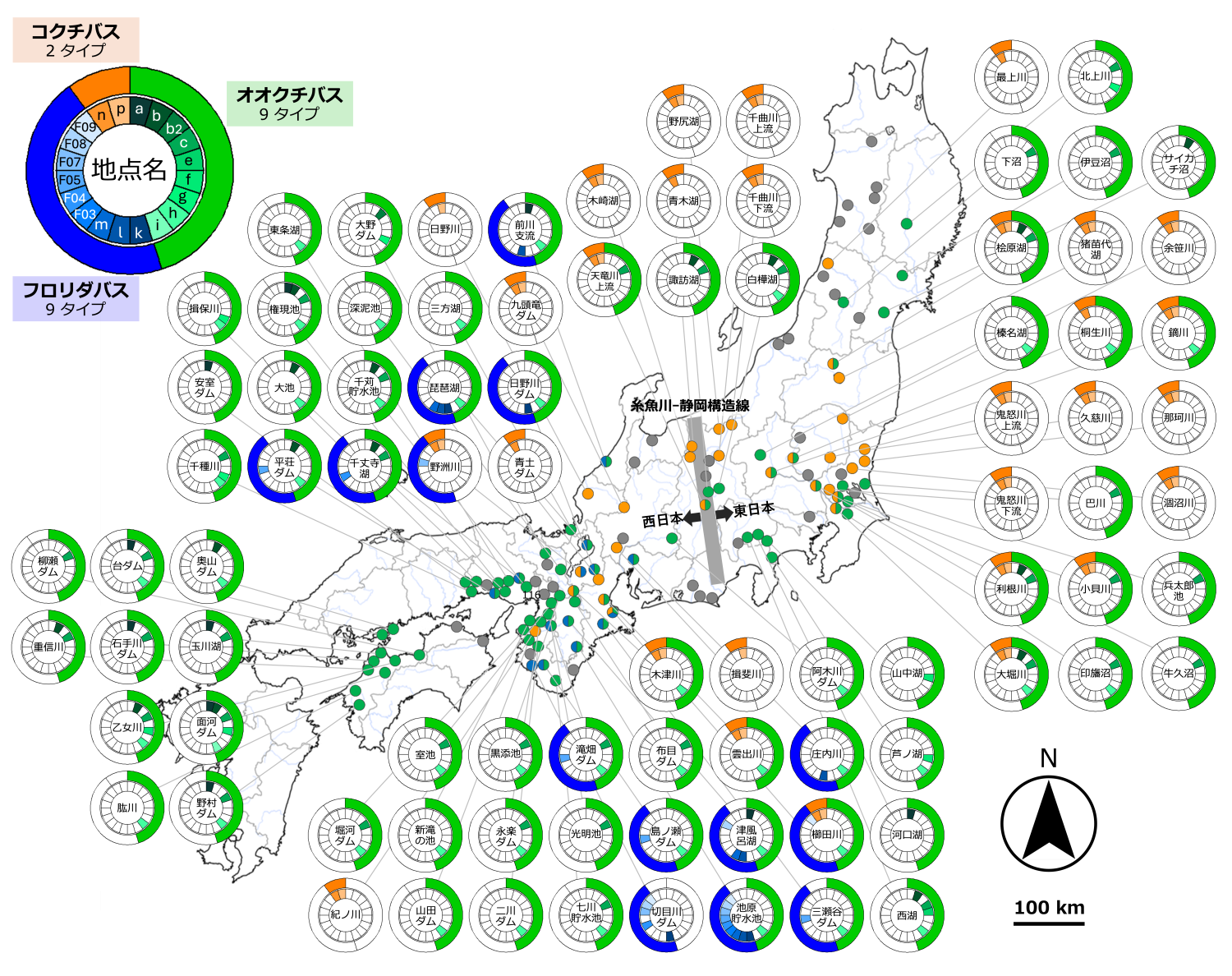
図2. オオクチバス(緑色、全9タイプ)、フロリダバス(青色、全9タイプ)、コクチバス(橙色、全2タイプ)のハプロタイプ分布。各ドーナツ図の中心に地点名を示す。外側のリングは種、内側のリングはハプロタイプを示す。地図上のグレーの点は未検出地点を示す。
<関連情報>
- https://www.nies.go.jp/pr/news-and-updates/2026/Press20260514.html
- https://onlinelibrary.wiley.com/doi/10.1002/edn3.70292
全国規模の環境DNAハプロタイピングにより、日本における3種の侵入性ブラックバスの生息域拡大が明らかになった Nationwide Environmental DNA Haplotyping Illuminates the Range Expansion of Three Invasive Black Bass Species in Japan
Kei Wakimura, Shin-ichiro S. Matsuzaki, Satoshi Kitano, Yoshiaki Tsuda, Jun-ichi Tsuboi, Tetsu Yatsuyanagi, Hiroki Hata, Narumi Tsugeki, Tomohiro Kando, Hitoshi Araki, Kimiko Uchii
Environmental DNA Published: 13 May 2026
DOI:https://doi.org/10.1002/edn3.70292
ABSTRACT
Invasive species pose a significant threat to ecosystems worldwide. To support effective management, it is crucial to clarify their distribution ranges and dispersal processes. Here, we applied an environmental DNA (eDNA)-based mitochondrial DNA haplotyping approach to invasive black bass species to characterize their invasion ranges and haplotype compositions, thereby inferring their dispersal processes. We conducted a nationwide eDNA survey focusing on three established species in Japan, i.e., Northern largemouth bass (Micropterus nigricans), Florida largemouth bass (M. salmoides), and Smallmouth bass (M. dolomieu). Our survey detected eDNA of at least one species at 87 of 121 sites, recovered most previously reported haplotypes, and showed strong concordance with capture-based data, demonstrating high sensitivity and accuracy. The haplotyping data revealed contrasting patterns among the three species. Northern largemouth bass, first introduced in 1925, is now widespread, with haplotype distribution suggesting gradual, localized geographic expansion across most regions. However, the high haplotype diversity observed on Shikoku Island, one of Japan’s major islands, despite invasion only after 1972, suggests extensive human-mediated translocations. Florida largemouth bass, introduced in 1988, was restricted to western Japan, with no signal of stepwise expansion, implying strong effects of human-mediated translocations. Smallmouth bass, a more recent invader, was broadly distributed with only two haplotypes detected; eDNA results closely matched recent governmental survey data on invasion fronts. Our findings highlight the influence of differing invasion histories and the ongoing role of human intervention in bass dispersal. This study demonstrates that the eDNA haplotyping enables broad-scale rapid monitoring while also providing insight into translocations and dispersal through population genetic structure, thereby facilitating efforts to prevent further invasions.