
2026-05-07 ミュンヘン大学(LMU)
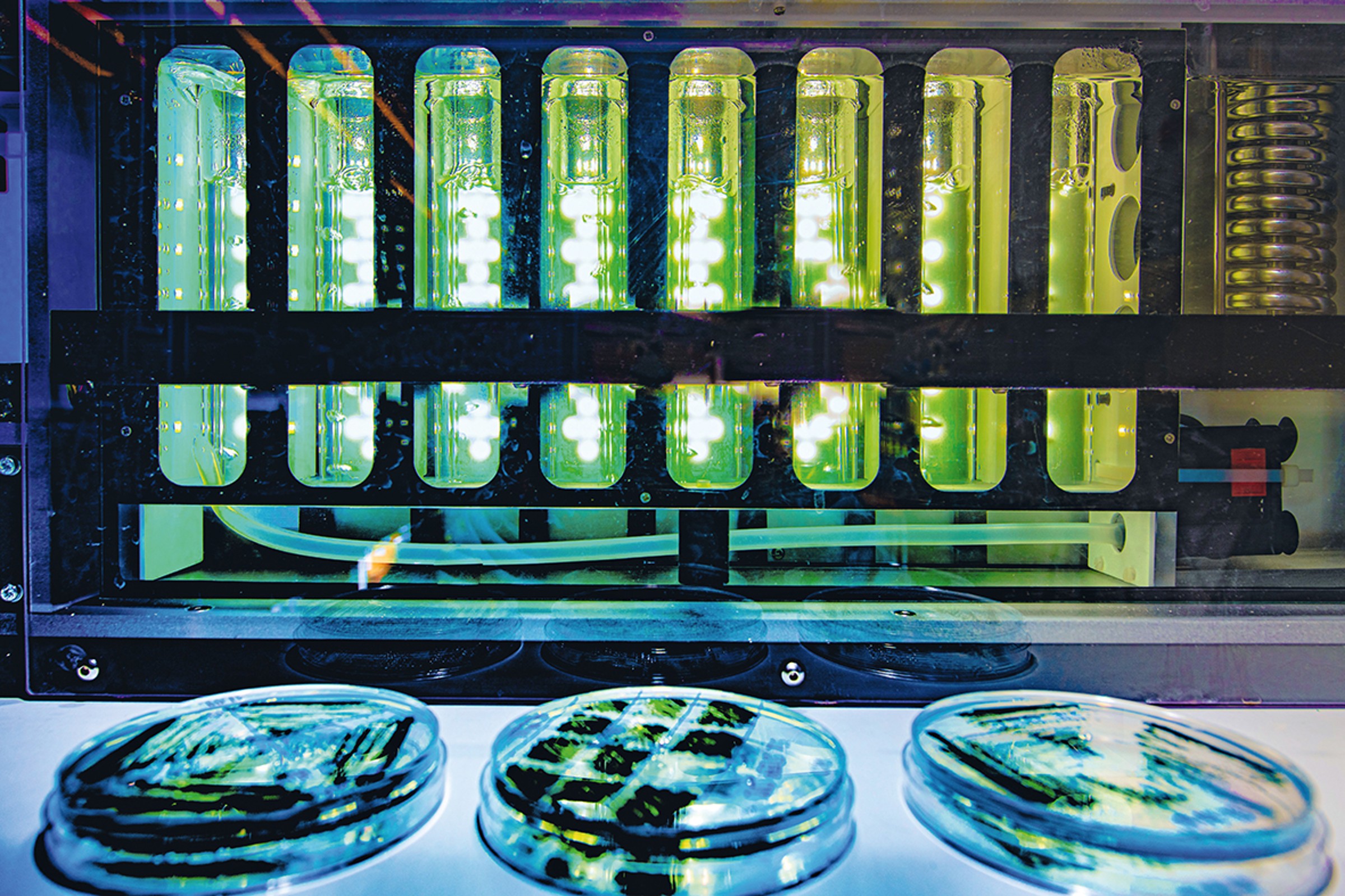
Adaptation in fast-forward
Dario Leister breeds cyanobacteria in the laboratory, exposes them to stress factors, and transfers the advantageous mutations to plants by means of genetic engineering.© Christoph Olesinski
<関連情報>
- https://www.lmu.de/en/newsroom/news-overview/news/better-prepared-for-fluctuating-light-stress-ac5575b4.html
- https://www.nature.com/articles/s41467-026-72689-x
シアノバクテリアであるシネコシスティスにおける適応的実験室進化による光変動耐性の向上 Improving tolerance to fluctuating light through adaptive laboratory evolution in the cyanobacterium Synechocystis
Theo Figueroa-Gonzalez,Weiyang Chen,Eslam M. Abdel-Salam,Daniel Štipl,Josef Komenda,Milena Zhivkovikj,Marcel Dann & Dario Leister
Nature Communications Published:04 May 2026
DOI:https://doi.org/10.1038/s41467-026-72689-x
Abstract
Fluctuating light (FL) poses a challenge to cyanobacteria by disrupting photosynthesis and damaging photosystems. Although key FL tolerance components are known, their genetic enhancement remains unexplored. We evolve Synechocystis PCC 6803 under two FL regimes (one lethal to the starter strain, LT) in order to identify previously unknown adaptive alleles. Our analysis reveals 44 mutations, 28 of which impact proteins/RNAs. Mutations in Pam68 (PSII assembly) and Sll0518, present in all strains, enhance non-lethal FL tolerance in LT. Mutated Pam68 increased PSII abundance and activity. A gain-of-function mutation in RpaB (regulator of phycobilisome association B) significantly increases tolerance to both lethal FL and high-light conditions. This is associated with an increased PSI/PSII ratio and downregulation of light harvesting. In summary, our results suggest that adaptive laboratory evolution can simultaneously identify FL tolerance factors and their advantageous alleles. The identified point mutations rewire multiple protective responses by as yet unknown molecular mechanisms.

