2026-05-08 中国科学院応用生態学研究所(IAE)

<関連情報>
- https://english.iae.cas.cn/research/202605/t20260508_1158597.html
- https://academic.oup.com/treephys/advance-article-abstract/doi/10.1093/treephys/tpag054/8661342
対照的な戦略、共通のリスク:12年間の窒素添加は、異なる経路を介して、幼木と成木における水力学的安全性を低下させる Contrasting strategies, shared risk: 12-yr nitrogen addition weakens hydraulic safety in young and mature trees via distinct pathways
Tao Yan ,Shijie Ning ,Tianyu Zhong ,Peilin Wang ,Jiaojun Zhu
Tree Physiology Published:23 April 2026
DOI:https://doi.org/10.1093/treephys/tpag054
Abstract
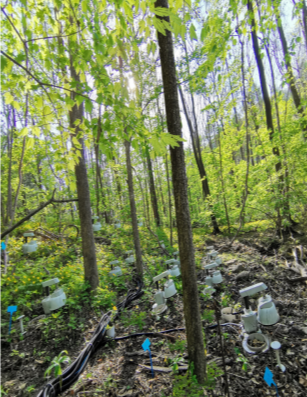
Nitrogen (N) deposition is widely assumed to stimulate growth in N-limited temperate forests, yet how N deposition interacts with tree ontogeny to regulate the carbon–water processes shaping tree resilience, decline, and mortality under environmental stress remains unclear. We used a 12-year anthropogenic N addition (control; N20: 20 kg N ha−1 year−1; and N50: 50 kg N ha−1 year−1) experiment spanning young, intermediate, and mature larch plantations in northern China to test age-dependent effects on hydraulics and nonstructural carbohydrates (NSCs) reserves. In young trees, N50 decreased soluble sugars in leaves, twigs, and branches, but increased in roots, suggesting a preferential belowground allocation, whereas N20 responses were limited. However, this apparent adaptive response was accompanied by increased xylem embolism vulnerability, indicating a potential trade-off between greater root carbon investment and hydraulic safety. In contrast, mature trees exhibited a tendency of systemic impairment of hydraulic function but with no signs of NSC reallocation. Our results demonstrate that decadal N addition disrupts carbon-water balance age-dependently: young trees trade hydraulic safety for carbon reallocation while mature trees undergo hydraulic decline. These findings challenge the view that N deposition uniformly benefits temperate forests and show that incorporating age-specific physiology is essential for predicting temperate forest dynamics.