2026-05-08 中国科学院応用生態学研究所(IAE)
<関連情報>
- https://english.iae.cas.cn/research/202605/t20260508_1158606.htmlhttps://english.cas.cn/newsroom/research-news/202605/t20260508_1158611.shtml
- https://onlinelibrary.wiley.com/doi/10.1111/gcb.70873
地形を介した土壌水分が森林斜面規模のNOおよびN₂O排出量を制御する Topography-Mediated Soil Moisture Controls Forest Hillslope-Scale NO and N2O Emissions
Kai Huang, Dongwei Liu, Yihang Duan, Di Wu, Geshere Abdisa Gurmesa, Ronghua Kang, Jingwen Xu, Xue Li, Yuqi Liu, Erik A. Hobbie, Xiaoming Fang, Chenxia Su, Zhi Quan, Ang Wang, Feifei Zhu …
Global Change Biology Published: 17 April 2026
DOI:https://doi.org/10.1111/gcb.70873
ABSTRACT
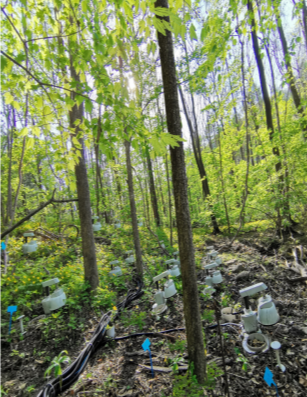
Temperate forests are key terrestrial carbon sinks, yet their capacity to sequester carbon is often limited by nitrogen (N), a nutrient whose availability is declining in many ecosystems. Among factors contributing to declining N availability, climate-driven changes in soil hydrology could force N loss via the emission of both nitric oxide (NO) and nitrous oxide (N2O); however, forecasting these losses is challenging because they are regulated by soil moisture, a factor that regulates microbial activity and substrate availability but varies significantly across space and time. Here, we ask: how do topography-driven soil moisture gradients and changes in seasonality (e.g., spring–thaw cycles) mediate hillslope-scale N emissions? We measured over 2 years of high-resolution in situ NO and N2O fluxes from 16 automated chambers deployed along a topographic gradient in a temperate forest to show that soil moisture gradients governed spatial and temporal patterns of soil N emissions. These gradients produced tradeoffs in process controls, whereby temperature regulated N emissions in drier upper positions, giving way to soil moisture regulating microbial pathways and emissions in wetter downslope positions. We then used these relationships among soil moisture, temperature, and N availability to develop models for predicting hillslope-scale NO + N2O losses. Annual emissions averaged 0.2 kg NO-N ha−1 (range: 0.1–0.3) and 1.0 kg N2O-N ha−1 (range: 0.7–4.9), with N2O showing a stronger response to moisture-driven changes than NO. The spring freeze–thaw period accounted for 15%–26% of NO and 24%–58% of N2O annual emissions, with the highest emissions measured consistently at lower topographic positions. These findings establish topography-mediated hydrology as a primary control of forest soil N dynamics and gaseous N emissions, reducing uncertainty in forecasts of hillslope-scale N losses under a changing climate.