2026-04-22 ミュンヘン大学(LMU)
<関連情報>
- https://www.lmu.de/en/newsroom/news-overview/news/breakthrough-in-the-simulation-of-complex-quantum-systems-61c8475e.html
- https://journals.aps.org/prl/abstract/10.1103/bx76-hps4
スペクトル分解と高精度グリーン関数:複素時間クリロフ展開によるナイキスト・シャノン限界の克服 Spectral Decomposition and High-Accuracy Green’s Functions: Overcoming the Nyquist-Shannon Limit via Complex-time Krylov Expansion
S. Paeckel
Physical Review Letters Published: 21 April, 2026
DOI: https://doi.org/10.1103/bx76-hps4
Abstract
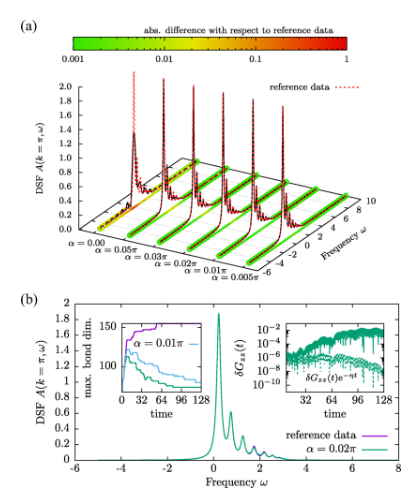
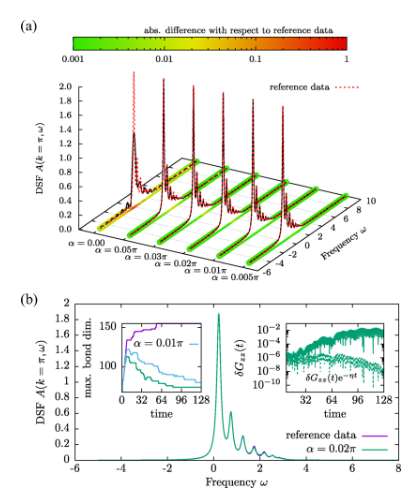
The accurate computation of low-energy spectra of strongly correlated quantum many-body systems, typically accessed via Green’s functions, is a long-standing problem posing enormous challenges to numerical methods. When the spectral decomposition is obtained from Fourier transforming a time series, the Nyquist-Shannon theorem limits the frequency resolution Δ according to the numerically accessible time domain size via Δ=2/. In tensor network methods, increasing the domain size is exponentially hard due to the ubiquitous spread of correlations, limiting the frequency resolution and thereby restricting this ansatz class mostly to one-dimensional systems with small quasiparticle velocities. Here, we show how this limitation can be overcome by augmenting the time series with complex-time Krylov states. With the example of the critical −1/2 Heisenberg model and light bipolarons in the two-dimensional Su-Schrieffer-Heeger model, we demonstrate the enormous improvements in accuracy, which can be achieved using this method.