2026-04-14 チャルマース工科大学
<関連情報>
- https://news.cision.com/chalmers/r/computational–time-machine–shows-solar-and-wind-on-track-for-2-c-target-but-not-for-1-5-c,c4333723
- https://www.nature.com/articles/s41560-026-02021-w
過去の各国の経験に基づく、世界の風力発電および太陽光発電の成長に関する確率的予測 Probabilistic projections of global wind and solar power growth based on historical national experience
Avi Jakhmola,Jessica Jewell,Vadim Vinichenko & Aleh Cherp
Nature Energy 14 April 2026
DOI:https://doi.org/10.1038/s41560-026-02021-w
Abstract
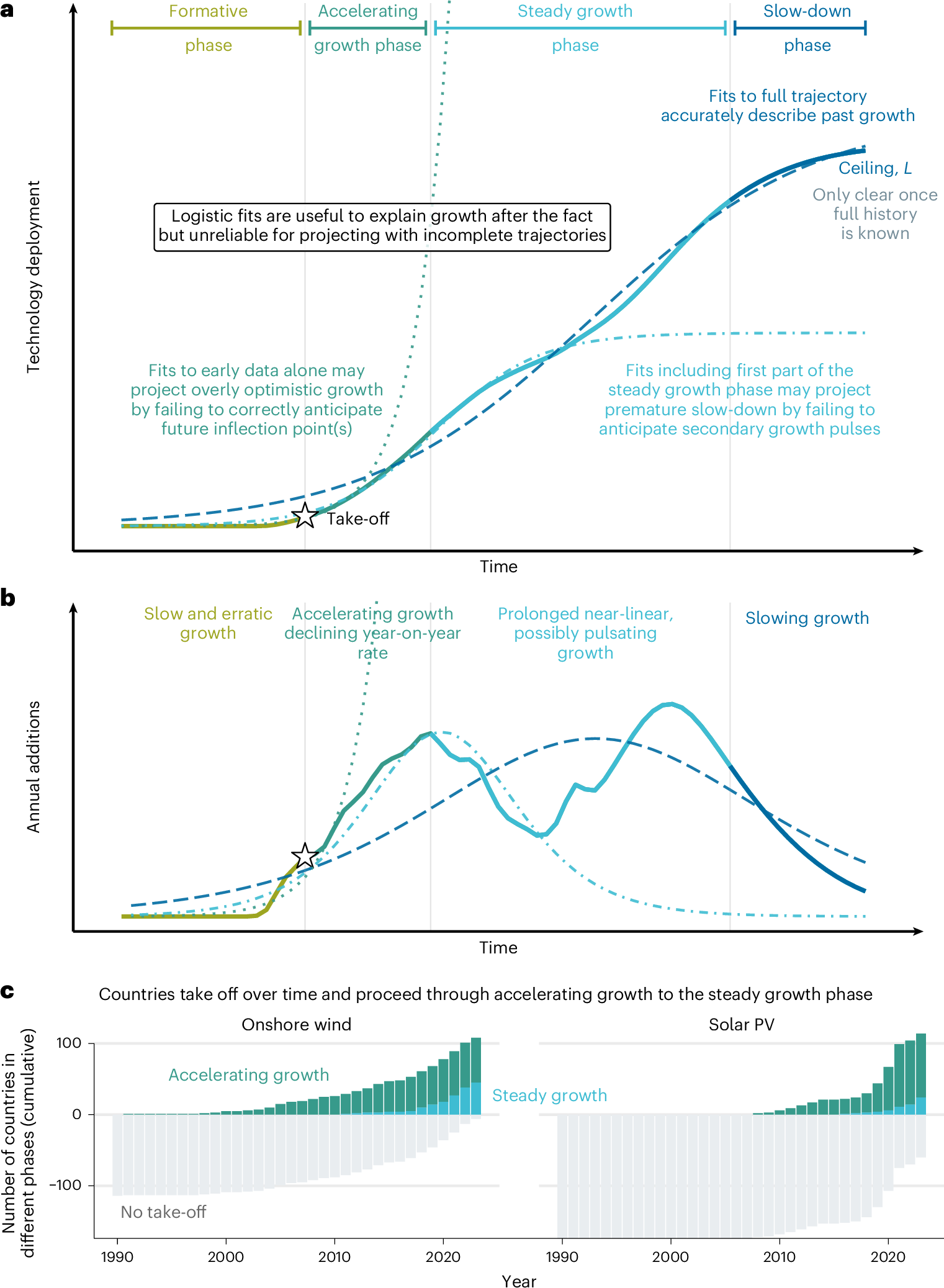
Despite the recent surge of wind and solar power, both technologies need to accelerate to meet climate goals. Yet, there are no robust methods to assess the likelihood of such acceleration. Here we show that renewable energy deployment follows a recurring pattern across countries with prolonged periods of relatively steady growth punctuated by growth pulses. Based on this insight and on observed growth trajectories in early adopting countries, we develop a probabilistic model (PROLONG) for projecting global wind and solar power deployment. In our central projections, both wind and solar power grow similarly to Intergovernmental Panel on Climate Change 2 °C-compatible pathways and faster than in current policy scenarios. The COP28 pledge to triple renewables by 2030 is near the 95th percentile of our projections and requires that the growth of wind and solar photovoltaics in major economies accelerate by 1.4–3 times and 2–5 times, respectively. PROLONG can be adopted for data-driven projections of other policy-dependent energy technologies.