026-03-30 カリフォルニア大学サンディエゴ校(UCSD)
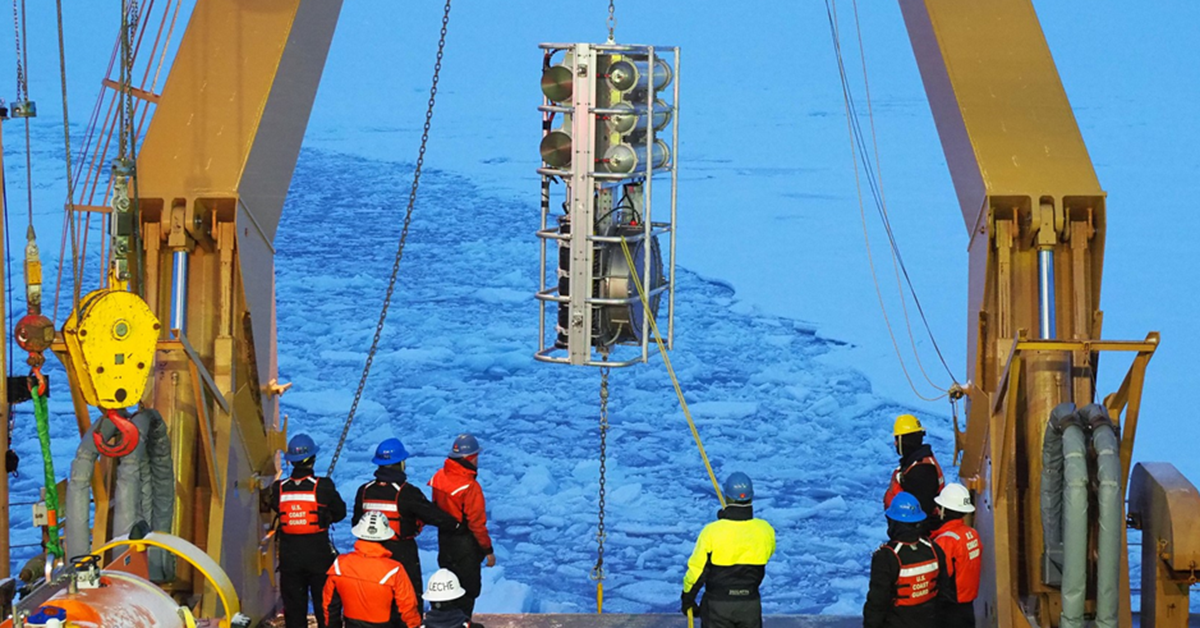
An acoustic sound source manufactured at the Marine Science Development Center for Scripps researcher Matthew Dzieciuch being deployed in the Arctic Ocean from the U.S. Coast Guard Icebreaker Healy. Acoustic systems like these are uniquely able to monitor under the ice where satellites are compromised, and provide an unprecedented look at the changing Arctic environment. Photo credit: Lee Freitag/WHOI
<関連情報>
- https://today.ucsd.edu/story/a-new-way-to-eavesdrop-on-ocean-temperature-in-the-arctic
- https://pubs.aip.org/asa/jasa/article/159/2/1071/3378473/Transarctic-acoustic-transmissions-during-the
2019~2020年の協調型北極音響温度測定実験における北極横断音響伝送
Transarctic acoustic transmissions during the coordinated Arctic acoustic thermometry experiment in 2019–2020
Matthew A. Dzieciuch;Hanne Sagen;Peter F. Worcester;Espen Storheim;F. Hunter Akins;Stein Sandven;John A. Colosi;John N. Kemp;Geir Martin Leinebø
The Journal of the Acoustical Society of America Published:February 02 2026
DOI:https://doi.org/10.1121/10.0042233
Acoustic signals with a center frequency of 35 Hz and a full bandwidth of about 4 Hz were transmitted over various ranges along a path extending from north of Svalbard to north of Alaska during the 2019–2020 US-Norwegian Coordinated Arctic Acoustic Thermometry Experiment (CAATEX). Three moorings were installed in the Canada Basin and three in the Nansen Basin, with one mooring in each basin hosting a source. All moorings had vertical receiving arrays, enabling spatial separation of the low-order acoustic normal modes. The modal group delays varied significantly over the year but were roughly consistent with predictions for the decade 2015–2022 based on the World Ocean Atlas 2023. The CAATEX signals traversed nearly the same trans-Arctic acoustic path as the 19.6-Hz signals in the 1994 Transarctic Acoustic Propagation (TAP) experiment. The TAP and CAATEX group delays cannot be directly compared because of the differing carrier frequencies. Thus, an indirect method using the group delays computed using WOA 2023 as a convenient standard was employed, but the large TAP mode-2 travel-time uncertainty precluded definitive comparisons. Nonetheless, CAATEX demonstrated that long-range acoustic transmissions provide precise, year-round measurements of large-scale ocean sound-speed (temperature) variability under the ice.