2026-03-27 カリフォルニア大学サンディエゴ校(UCSD)
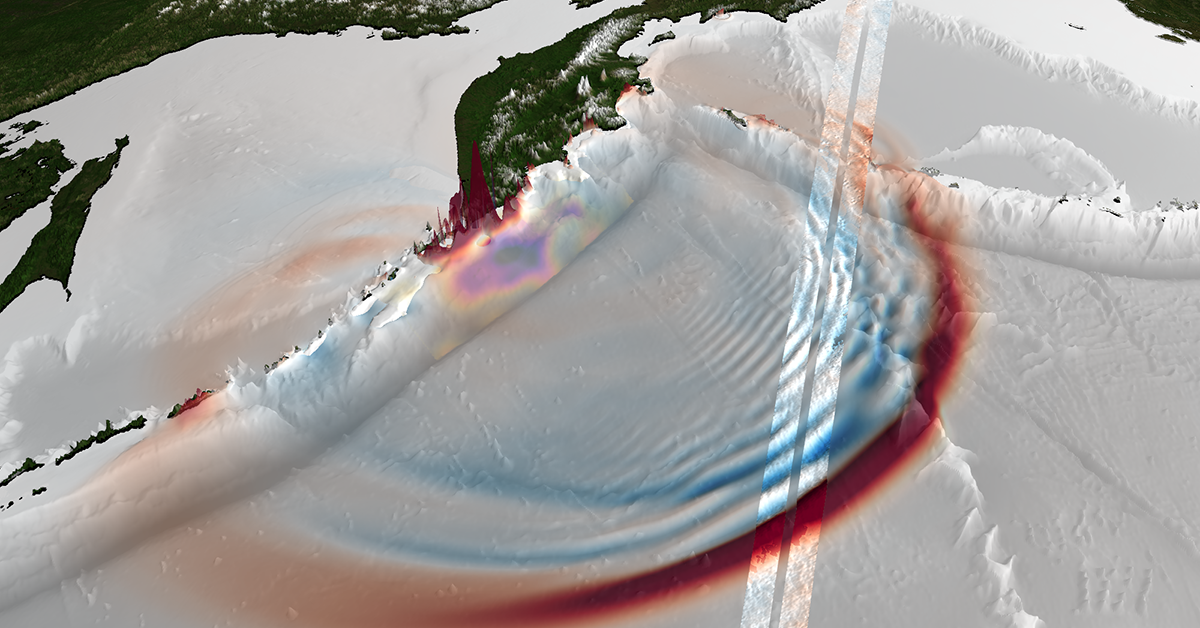
SWOT observations of the tsunami wave field offshore Kamchatka about one hour after the earthquake covering the two parallel diagonal lines cutting across the image. The measurements allowed the researchers to work backwards to infer the seafloor deformation (yellow–purple pattern) that gave rise to the tsunami and enabled simulations that matched the SWOT observations. Credit: Bjarke Nilsson
<関連情報>
- https://today.ucsd.edu/story/new-satellites-observations-close-blind-spot-in-tsunami-science
- https://www.science.org/doi/10.1126/science.aeb8634
SWOTは、2025年のカムチャツカ地震において、海溝付近の震源に関連した分散型津波を検出した SWOT detects dispersive tsunami tied to a near-trench source in the 2025 Kamchatka earthquake
Ignacio Sepúlveda , Bjarke Nilsson , Yao Yu , Matías Carvajal, […] , and David Sandwell
Science Published:26 Mar 2026
DOI:https://doi.org/10.1126/science.aeb8634
Editor’s summary
On 29 July 2025, the Kamchatka moment magnitude 8.8 earthquake triggered a Pacific-wide tsunami that happened to be imaged during a flyover of the NASA/CNES Surface Water and Ocean Topography (SWOT) mission. Sepúlveda et al. used the centimeter-scale SWOT data to analyze the tsunami’s trailing waves, which had the dispersion and short wavelengths typical of shallow subduction-zone earthquakes. Together with land-deformation data and seafloor pressure sensors, the SWOT data allowed a high-resolution estimate of the depth of slip during the Kamchatka event. This application shows how SWOT can integrate with other sensing methods to understand tsunami-prone earthquakes. —Angela Hessler
Abstract
Tsunamis from large subduction earthquakes pose severe coastal hazards, yet their genesis near the trench remains poorly constrained by land-based seismic geodetic data and distant deep-water sensors. Following the 29 July 2025 magnitude 8.8 Kamchatka earthquake, the NASA/CNES Surface Water and Ocean Topography (SWOT) satellite captured a distinct train of short-wavelength tsunami waves, which we link to near-trench tsunamigenesis. Sensitivity analyses of earthquake slip indicated tsunamigenesis within 10 kilometers of the trench, an inference not attainable from land seismology and geodesy or sparse deep-water seafloor pressure records alone. These results provide the first high-resolution, two-dimensional spaceborne observation directly linking the measured dispersive tsunami wavefield to near-trench tsunamigenesis, extending earlier model- and gauge-based inferences. They establish SWOT as a constraint on source processes, with implications for tsunami hazard science and subduction-zone geodynamics.