2026-03-25 ミュンヘン大学(LMU)
<関連情報>
- https://www.lmu.de/en/newsroom/news-overview/news/unravelling-active-magma-by-drilling-in-the-heart-of-volcanoes-2e5d6d90.html
- https://www.nature.com/articles/s41586-026-10317-w
地殻マグマの採取に対する不均衡反応が貯蔵条件を明らかにする Disequilibrium response to tapping crustal magma reveals storage conditions
Janine Birnbaum,Fabian B. Wadsworth,Jackie E. Kendrick,Ben Kennedy,Paul A. Wallace,Marize Muniz da Silva,Kai-Uwe Hess & Yan Lavallée
Nature Published:25 March 2026
DOI:https://doi.org/10.1038/s41586-026-10317-w
Abstract
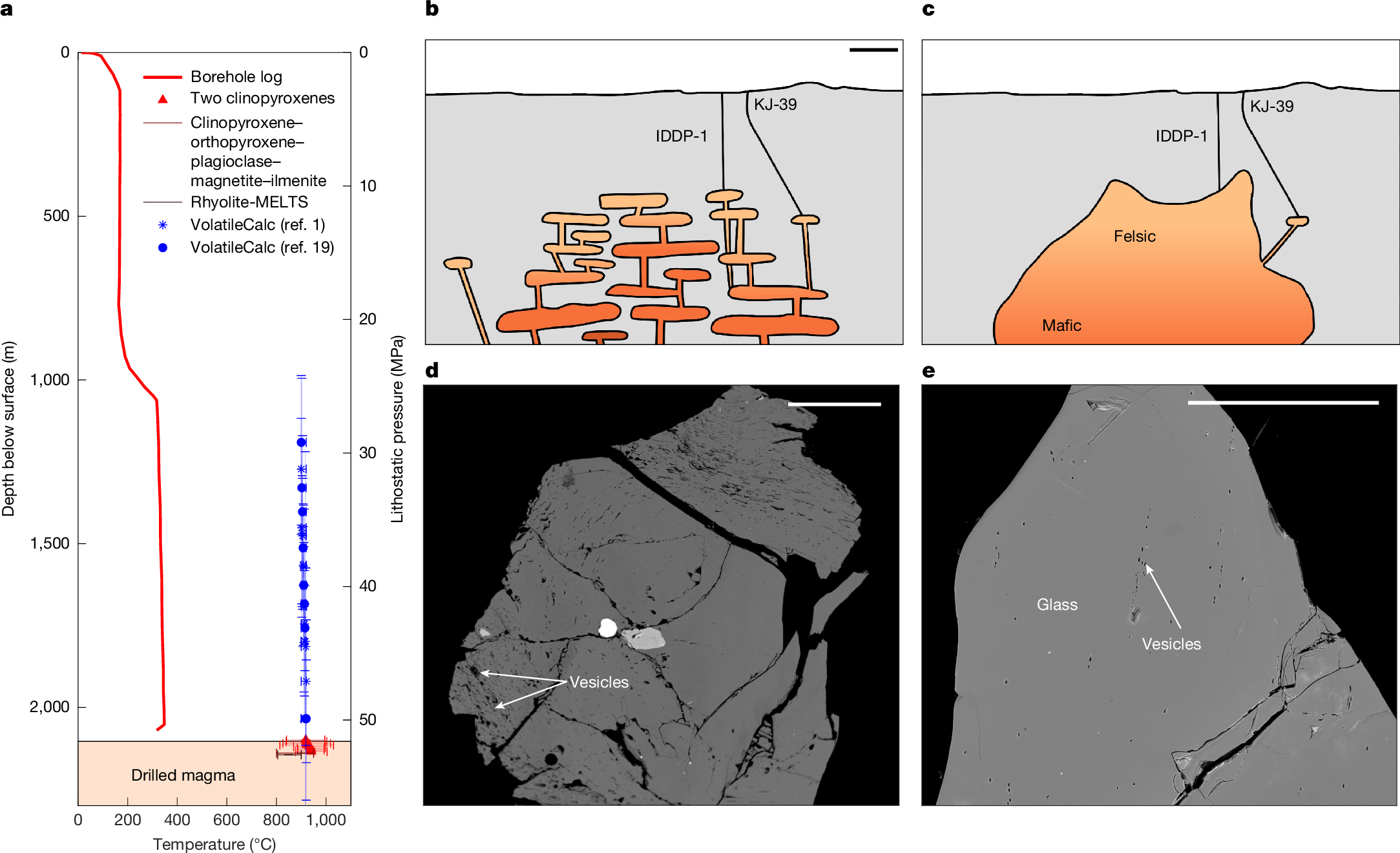
The conditions under which magma accumulates and is stored are fundamental to unravelling the processes of crust formation, planetary differentiation, geothermal heat recharge and volcanic eruptions. Storage pressure, temperature and volatile saturation are typically inferred from erupted volcanic products. However, changes during kilometres of magma ascent induce disequilibrium crystallization and vesiculation, and inverting back to storage conditions comes with unresolvable uncertainties. Here we explore opportunities arising from magma drilling at Krafla volcano, Iceland, to reconstruct real, in situ magmatic conditions. The findings show that, over the approximately 5 min in which the magma is quenched, vapour bubbles consisting of H2O and CO2 exsolve, grow and resorb, but the changes can be accounted for by multiparametric inversion (for chemistry, vesicularity and vitrification), and that the magma was stored under volatile-saturated lithostatic conditions, unlike previous assertions of lower vapour pressures based on classic methods1. These new disequilibrium simulations reconcile the glass chemistry with conceptual models of magma storage and provide us with the unique pairing of precisely measured depth and volatile pressure on a single magma body and thus a robust method to improve our understanding of magma storage conditions and evolution.