2026-03-18 中国科学院(CAS)
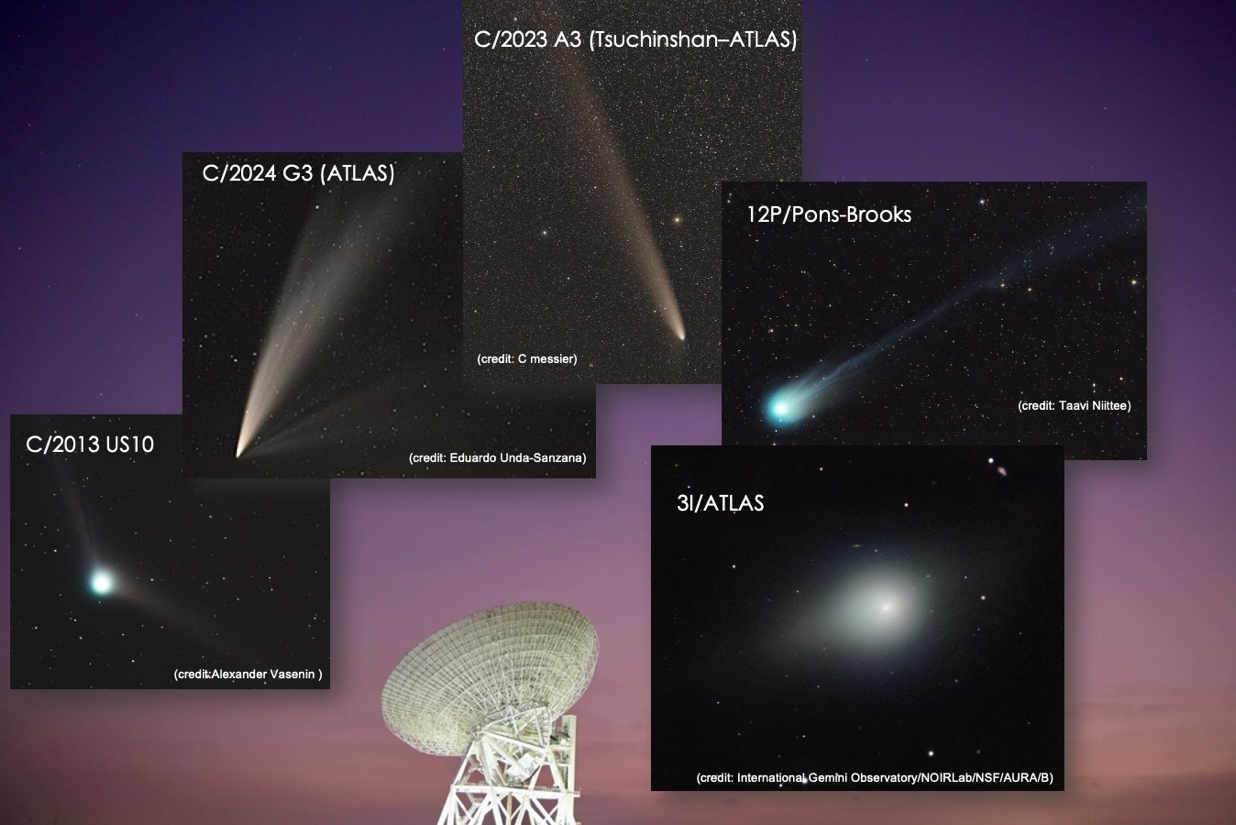
The Tianma Radio Telescope and some of the comets it has observed. (Image by SHAO)
<関連情報>
- https://english.cas.cn/newsroom/research-news/202603/t20260319_1152921.shtml
- https://iopscience.iop.org/article/10.3847/2041-8213/ae45a2
星間彗星3I/ATLASの近日点通過前の揮発性物質の進化は、彗星のコマにある広範囲にわたる発生源からの重要な寄与を示唆している Preperihelion Volatile Evolution of Interstellar Comet 3I/ATLAS Indicating Significant Contribution from an Extended Source in the Coma
Juncen Li, Xian Shi, Man-To Hui, and Jianchun Shi
The Astrophysical Journal Letters Published: 2026 February 25
DOI:10.3847/2041-8213/ae45a2
Abstract
Interstellar comets provide rare opportunities for probing the diversity of refractory and volatile inventory around other stars. As the second ever interstellar comet and the third interstellar object, 3I/ATLAS has been the focus of telescopic observations since its discovery in 2025 July. Following the previous observations at multiwavelengths, we present further radio observations of the 1665/1667 MHz ground-state OH lines and millimeter observations of the CO(J = 1–0) transition at 115.271 GHz that trace the coma H2O and CO abundances, respectively. We derived OH production rates of (1.32 ± 0.47) × 1028 s−1 at 2.27 au and (1.89 ± 0.37) × 1028 s−1 at 1.96 au, as well as an average CO production rate of (5.75 ± 1.91) × 1027 s−1 between 2.33 and 1.75 au, inferring a CO/H2O ratio of (28% ± 11%). With the mean HCN production rate of 2.5 × 1025 s−1 at 2.1 au reported by N. X. Roth et al. and I. M. Coulson et al., we infer a CO/HCN ratio of (230 ± 76). By synthesizing water production rates measured with instruments of different apertures, we found that the sublimation from an extended source in the coma contributes significantly to 3I’s preperihelion water measurements, accounting for up to 80% from 3 to 2 au.