2026-03-09 ニューヨーク大学 (NYU)
<関連情報>
- https://www.nyu.edu/about/news-publications/news/2026/march/battery-testing.html
- https://pubs.rsc.org/en/Content/ArticleLanding/2026/SC/D5SC04419G
超低磁場核磁気共鳴法による電池電解質組成の非破壊観察の実現 Enabling nondestructive observation of electrolyte composition in batteries with ultralow-field nuclear magnetic resonance
Anne M. Fabricant, Román Picazo-Frutos, Florin Teleanu, Gregory J. Rees, Raphael Kircher, Mengjiang Lin, William Evans, Paul-Martin Luc, Robert A. House, Peter G. Bruce, Peter Krüger, John W. Blanchard, James Eills, Kirill F. Sheberstov, Rainer Körber, Dmitry Budker, Danila A. Barskiy and Alexej Jerschow
Chemical Science Published:29 Jan 2026
DOI:https://doi.org/10.1039/D5SC04419G
Abstract
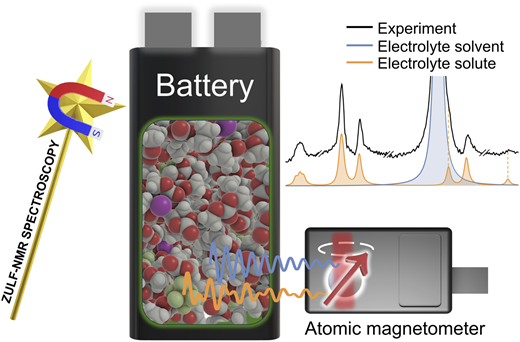
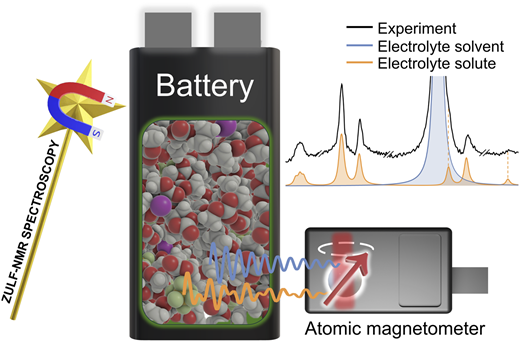
Rechargeable batteries represent a key transformative technology for electric vehicles, portable electronics, and renewable energy. Yet, there are few nondestructive diagnostic techniques compatible with realistic commercial cell enclosures. Many battery failures result from the loss or chemical degradation of the electrolyte. In this work, we present measurements through battery enclosures that allow quantification of electrolyte amount and composition. The study employs instrumentation and techniques developed in the context of zero-to-ultralow-field nuclear magnetic resonance (ZULF NMR), with quantum magnetometers as the detection elements (atomic optically pumped magnetometers, OPMs, and superconducting quantum interference devices, SQUIDs, used in this work). In contrast to conventional NMR methodology, which suffers from skin-depth limitations, the reduced resonance frequencies in ZULF NMR make battery housing and electrodes transparent to the electromagnetic fields involved. As demonstrated here through simulation and experiment, both the solvent and lithium-salt components of the electrolyte (lithium hexafluorophosphate, LiPF6) signature can be quantified using our techniques. Further, we show that the ZULF-NMR apparatus and technique are compatible with measurements of pouch-cell batteries.