2026-02-27 九州大学
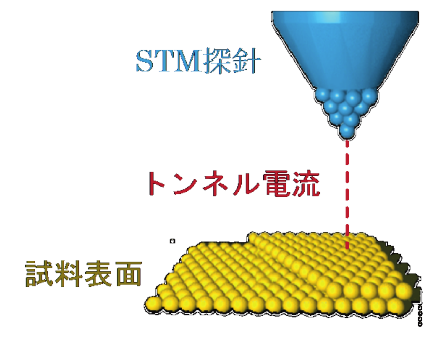
図1:走査トンネル顕微鏡の模式図。
<関連情報>
- https://www.kyushu-u.ac.jp/ja/researches/view/1429
- https://www.kyushu-u.ac.jp/f/64972/26_0227_01.pdf
非キラル分子の対形成による創発的キラル性:Au(111)上の対をなす1,10-フェナントロリンの同キラル鎖 Emergent Chirality from Pairing of Achiral Molecules: Homochiral Chains of Paired 1,10-Phenanthroline on Au(111)
Erlina Tik Man, Yuya Kaneko, Ryunosuke Kobata, Muhammad Alief Irham, Takaya Shimokawa, Tzu-Yen Chen, Yukiko Obata, Kazutoshi Shimamura, Kenji Hayashida, Kotaro Takeyasu, …
Advanced Materials Interfaces Published: 15 February 2026
DOI:https://doi.org/10.1002/admi.202501092
ABSTRACT
Understanding how chirality emerges from assemblies of achiral molecules is central to the study of symmetry breaking at surfaces. Here we show that achiral 1,10-phenanthroline adsorbed on Au(111) generates chirality through a pairing-driven hierarchical self-assembly pathway. Upon adsorption, molecules selectively form hydrogen-bonded pairs via weak but directional C─H···N interactions. Steric and electrostatic constraints restrict this interaction to two molecules, forcing a choice between two symmetry-equivalent nitrogen sites and thereby producing left- or right-handed molecular pairs that act as local chiral motifs. These motifs organize through attractive intermolecular interactions into homochiral one-dimensional chains, which further assemble into two-dimensional chiral domains governed by repulsive interchain interactions. Scanning tunneling microscopy directly visualizes mirror-related left- and right-handed domains. Density functional theory calculations confirm that the face-to-face paired configuration is energetically preferred and stabilized by adsorption on Au(111). This work reveals a distinct route to surface chirality in which chirality originates at the level of a hydrogen-bonded molecular pair and is amplified into organized chiral architectures through weak intermolecular interactions.