
2026-02-12 東京大学,北海道大学
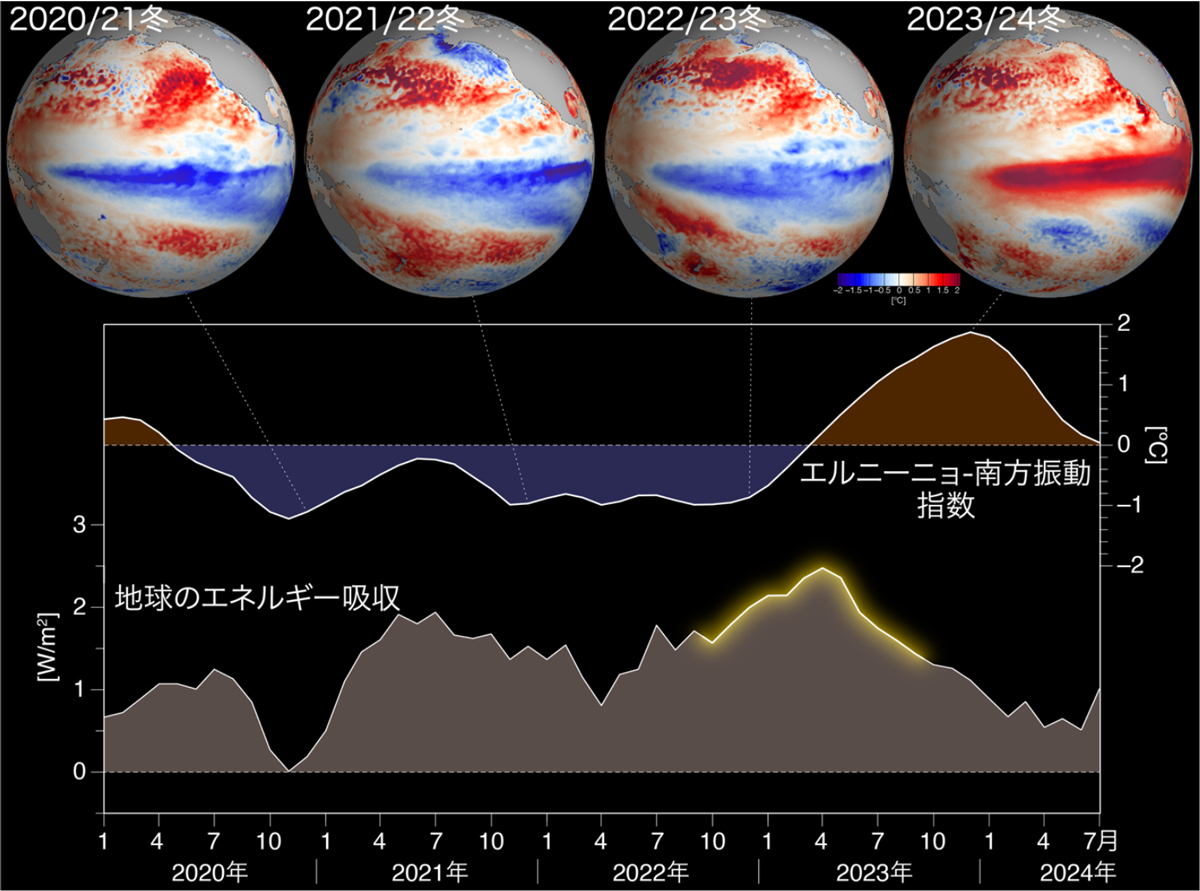
2020年初頭から2024年夏までのエルニーニョ・南方振動の様子と地球のエネルギー吸収
<関連情報>
- https://www.rcast.u-tokyo.ac.jp/ja/news/release/20260212.html
- https://www.nature.com/articles/s41561-026-01921-6
複数年にわたるラニーニャ現象からエルニーニョ現象への移行は、2022年から2023年の地球の極端なエネルギー摂取に影響を与えた Multi-year La Niña–El Niño transition influenced Earth’s extreme energy uptake in 2022–2023
Ko Tsuchida,Yu Kosaka & Shoshiro Minobe
Nature Geoscience Published:12 February 2026
DOI:https://doi.org/10.1038/s41561-026-01921-6
Abstract
Earth’s energy uptake—defined as the global mean net incoming radiation at the top of the atmosphere—surged in 2022–2023, contributing to record global surface temperatures and widespread climate extremes in 2023–2024. Yet, the causes of this extreme energy uptake remain unclear, reflecting limited knowledge of how internal climate variability shapes Earth’s energy imbalance. Here we investigate the drivers of the observed extreme energy uptake by using multi-model climate simulations and satellite-based observations. We show that the transition from the multi-year La Niña to El Niño was key to Earth’s extreme energy uptake in 2022–2023, upon the externally forced positive imbalance. Our sampling analyses from the multi-model simulation dataset highlight the dominant influence of the La Niña-to-El Niño sequence on enhanced energy uptake, with crucial importance of multi-year persistence in preceding La Niña. When combined with estimates of the externally forced component derived under Shared Socio-economic Pathway scenarios, the contribution associated with the La Niña-to-El Niño transition explains about 75% of the observed extreme energy uptake. Our finding underscores the role of internal climate variability in shaping Earth’s energy budget and its potential amplification under a warming climate.
