2026-02-10 琉球大学
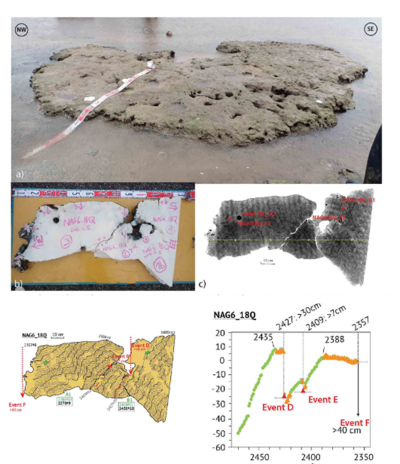
図1 名蔵湾(石垣島)にあるサンゴのマイクロアトール
<関連情報>
数千年前のサンゴ礁微小環礁から亜熱帯日本における巨大地震と地震超周期の証拠が発見される Evidence of megathrust earthquakes and seismic supercycles in subtropical Japan from millennia-old coral microatolls
Sophie Debaecker,Nathalie Feuillet,Kenji Satake,Kohki Sowa,Masaki Yamada,Tetsuro Sato,Mamoru Nakamura,Atsushi Watanabe,Ayaka Saiki,Jean-Marie Saurel,Giovanni Occhipinti,Tsai-Luen Yu & Chuan-Chou Shen
Nature Communications Published:10 February 2026
DOI:https://doi.org/10.1038/s41467-025-67724-2
Abstract
Megathrust earthquakes in subduction zones often go unreported because they are rare and the historical record is short. On the Ryukyu subduction zone of southwestern Japan, unlike neighboring Nankai Trough, the history and future potential of great interplate earthquakes are not well known. While the geodetic measurements on the islands suggest that the plate coupling is very weak, recent observations of slow seismic events as well as offshore geodetic measurements imply the presence of coupled patches along the megathrust. Furthermore, the historical and geological studies indicate evidence of great tsunamis. Here, we use fossil microatolls in Ishigaki island to reconstruct the relative sea level in the Holocene. The coral record reveals several relative emergence episodes clustering between 5-4 and 3-2 thousand years ago (ka). Elastic modeling shows that the observed motions can correspond to coseismic uplift associated with megathrust earthquakes. The clusters of megathrust events suggest possible supercycles of earthquakes with a recurrence interval of more than 2 ka. Such results imply a strong seismic hazard for the upcoming centuries. The devastating 1771 Meiwa earthquake and associated tsunami may mark the onset of the most recent seismic supercycle.